
The Global Institute for Strategic Studies (GISS)
Executive Summary
The Strait of Hormuz has once again emerged as one of the most consequential geopolitical flashpoints in the international system following the military confrontation involving Iran, Israel, and the United States during the first half of 2026. Although commercial navigation has gradually resumed after weeks of heightened military tensions and intensive diplomatic mediation, the crisis has fundamentally transformed global assessments of maritime security, strategic energy resilience, and the vulnerability of international supply chains. What initially appeared to be a regional confrontation rapidly evolved into a global strategic concern as financial markets, energy exporters, shipping companies, insurance providers, and governments confronted the possibility that one of the world’s most important maritime chokepoints could become inaccessible for an extended period.
Unlike previous crises in the Gulf, the events of 2026 demonstrated that disruptions in the Strait of Hormuz produce consequences extending far beyond oil prices alone. International shipping costs increased significantly, marine insurance premiums reached levels unseen in years, global financial markets experienced heightened volatility, and governments were forced to reassess the resilience of critical supply chains that depend heavily upon uninterrupted maritime commerce. The crisis exposed structural vulnerabilities within the global economy, revealing that despite decades of diversification efforts, the international trading system remains deeply dependent upon a limited number of strategic maritime corridors whose security cannot be guaranteed during periods of geopolitical confrontation.
The crisis also accelerated a broader transformation in international strategic thinking. Maritime chokepoints are no longer viewed merely as geographical constraints but increasingly as instruments capable of influencing diplomacy, economic stability, military planning, and political decision-making simultaneously. In this context, the Strait of Hormuz has evolved into a strategic pressure point where military deterrence, international law, energy security, and great-power competition increasingly intersect. The decisions taken by regional actors regarding navigation, military deployments, and diplomatic engagement now carry consequences extending across Europe, Asia, North America, and the wider international economy.
This paper argues that the 2026 Hormuz crisis represents more than a temporary disruption to global energy markets. Instead, it marks the beginning of a new strategic era in which maritime security will occupy a central position within international security planning. Governments can no longer approach maritime infrastructure solely through the lens of naval operations; instead, they must integrate economic resilience, diplomatic coordination, technological surveillance, energy diversification, and multinational crisis management into a comprehensive strategy capable of reducing future vulnerabilities.
Introduction
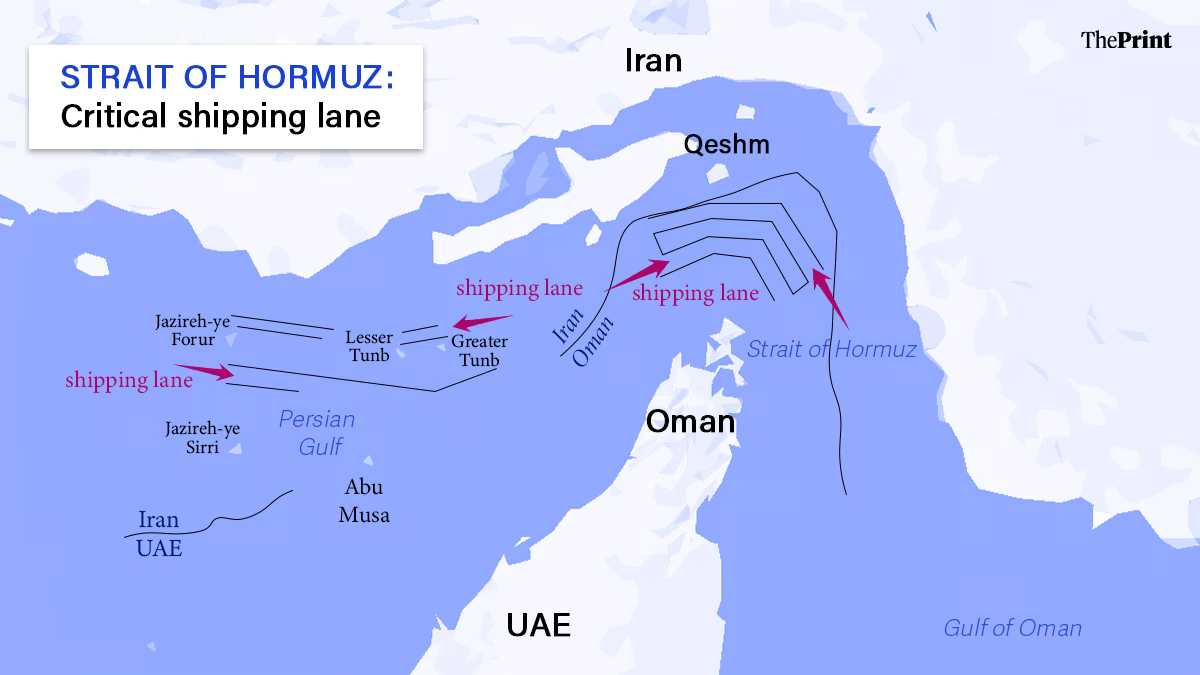
For decades, the Strait of Hormuz has occupied a unique position within the architecture of global commerce and international security. Connecting the Persian Gulf to the Gulf of Oman and the Arabian Sea, the narrow waterway serves as the principal maritime gateway for energy exports originating from some of the world’s largest oil- and gas-producing states. Every day, millions of barrels of crude oil, refined petroleum products, liquefied natural gas, petrochemicals, and commercial goods transit through this strategically vital corridor before reaching markets across Europe, Asia, and North America. The uninterrupted operation of Hormuz has therefore become not only a regional concern but also a fundamental requirement for maintaining stability within the international economic system.
Despite its strategic importance, policymakers often viewed the risks associated with Hormuz through a relatively narrow military lens. Earlier periods of tension were generally interpreted as short-term security challenges that could be managed through naval deployments, diplomatic pressure, or limited military deterrence. The events of 2026 fundamentally challenged this assumption. The confrontation involving Iran, Israel, and the United States demonstrated that even without a prolonged closure of the Strait, uncertainty surrounding commercial navigation was sufficient to generate immediate global economic consequences. Financial markets reacted within hours, energy prices fluctuated sharply, insurance costs escalated, and commercial shipping companies began reassessing operational risks long before any formal restrictions on maritime traffic had been implemented.
More importantly, the crisis highlighted how globalization has amplified the strategic significance of maritime infrastructure. Modern economies rely upon highly integrated supply chains in which even temporary disruptions to shipping routes can affect industrial production, inflation, food security, manufacturing, transportation costs, and financial stability. The Strait of Hormuz therefore represents far more than an energy corridor; it has become one of the world’s most influential strategic nodes, capable of shaping international political calculations through its impact on global economic resilience. As geopolitical competition intensifies among regional and international powers, the ability to ensure secure and uninterrupted maritime navigation will increasingly determine both economic stability and strategic influence.
Against this backdrop, the events of 2026 should not be interpreted simply as another episode in the long history of Gulf tensions. Instead, they reveal a broader transformation in the relationship between geography and power. Maritime chokepoints such as the Strait of Hormuz are becoming central arenas where military competition, diplomatic negotiations, technological capabilities, and economic interdependence converge. Understanding this transformation is essential for anticipating future security challenges and developing policies capable of protecting one of the world’s most critical arteries of international trade.
The 2026 Hormuz Crisis: From Regional Escalation to Global Economic Shock
The 2026 crisis surrounding the Strait of Hormuz demonstrated how rapidly a regional military confrontation can evolve into a global economic emergency. Although previous confrontations between Iran and Western powers repeatedly raised concerns over freedom of navigation, the latest escalation differed significantly in both scale and international impact. Military exchanges between Iran, Israel, and the United States generated immediate uncertainty over the future of commercial navigation through the Strait, prompting international shipping companies, energy traders, insurers, and financial institutions to reassess operational risks almost overnight. The resulting disruption extended well beyond the Gulf itself, affecting oil markets, international trade, financial stability, and supply-chain planning across multiple continents.
Unlike conventional military conflicts that primarily influence regional security dynamics, the Hormuz crisis rapidly affected sectors that traditionally remain detached from armed confrontation. International freight costs increased as insurers classified voyages through the Gulf as high-risk operations, requiring significantly higher premiums for vessels entering the region. Energy traders reacted by incorporating geopolitical uncertainty into global pricing models, while governments activated contingency plans to monitor fuel supplies and strategic reserves. Markets responded not only to actual disruptions but also to the possibility that prolonged instability could interrupt one of the world’s most important commercial corridors. This demonstrated that modern geopolitical crises increasingly derive their strategic influence from uncertainty rather than from direct military outcomes alone.
The crisis also exposed the interconnected nature of today’s global economy. European manufacturers dependent upon imported energy immediately faced rising production costs. Asian economies closely monitored potential interruptions to crude oil and liquefied natural gas supplies. Financial markets experienced increased volatility as investors evaluated the wider consequences of sustained instability in the Gulf. The events illustrated that maritime security has become inseparable from economic resilience, transforming Hormuz into a strategic variable capable of influencing monetary policy, inflation, industrial competitiveness, and international investment simultaneously.
Perhaps the most significant lesson emerging from the crisis is that the global economy remains remarkably vulnerable despite decades of diversification efforts. Alternative pipelines, strategic petroleum reserves, and diversified suppliers have undoubtedly reduced dependence on individual producers, yet no comparable alternative currently exists for replacing the commercial importance of the Strait of Hormuz itself. Geography continues to impose strategic constraints that technological innovation alone has been unable to eliminate.
Iran’s Strategic Leverage and the Politics of Maritime Chokepoints
For decades, analysts have debated whether Iran would ever attempt to disrupt navigation through the Strait of Hormuz during periods of heightened confrontation. The events of 2026 demonstrated that Tehran does not necessarily need to close the Strait completely in order to exercise considerable geopolitical leverage. The mere possibility of disruption proved sufficient to influence international markets, shape diplomatic negotiations, alter military planning, and attract global political attention.
This form of strategic leverage reflects a broader transformation in international security. Rather than relying exclusively upon conventional military superiority, states increasingly exploit geographic advantages, economic interdependence, and infrastructure vulnerabilities to strengthen their negotiating position. In Iran’s case, its proximity to one of the world’s most strategically significant maritime corridors provides an enduring source of influence that extends beyond traditional measures of military or economic power.
The Hormuz crisis therefore illustrated how maritime geography itself has become an instrument of strategic competition. The ability to generate uncertainty surrounding commercial navigation creates political pressure upon energy-importing countries, multinational corporations, shipping operators, and financial markets without requiring sustained military engagement. This represents an increasingly sophisticated form of geopolitical influence in which perceptions of risk become almost as significant as actual military operations.
Nevertheless, Iran also faces important strategic limitations. Any prolonged interruption of maritime traffic would inevitably damage regional economies, reduce energy exports, and intensify international diplomatic and economic pressure. Consequently, Tehran’s leverage depends less upon permanently disrupting Hormuz than upon maintaining sufficient uncertainty to strengthen its bargaining position during periods of heightened regional tension.
Maritime Security Beyond Naval Power
One of the defining characteristics of the 2026 crisis was the recognition that naval superiority alone cannot guarantee secure commercial navigation. Throughout previous decades, freedom of navigation was largely interpreted as a military responsibility requiring the deployment of naval assets to deter potential threats. While military capabilities remain indispensable, the latest crisis demonstrated that commercial confidence depends equally upon diplomatic coordination, intelligence sharing, legal certainty, technological surveillance, and cooperation between governments and the private sector.
International shipping companies increasingly emphasized that commercial decisions are determined by overall risk assessments rather than by the physical presence of naval vessels alone. Even after military tensions began to subside, many operators delayed returning to normal shipping schedules until insurers reduced premiums, governments issued updated security guidance, and confidence in regional stability gradually improved. This illustrates an important evolution in maritime security thinking. Modern shipping depends upon predictability, transparency, and coordinated crisis management as much as upon military deterrence.
The crisis also highlighted the growing importance of technological capabilities in maritime governance. Satellite surveillance, artificial intelligence, real-time vessel tracking, cybersecurity systems, and integrated intelligence networks played a central role in monitoring commercial activity and assessing operational risks throughout the confrontation. Future maritime security strategies will increasingly combine traditional naval operations with advanced technological systems capable of providing continuous situational awareness across critical sea lanes.
Consequently, the future governance of strategic maritime corridors such as Hormuz is likely to become more internationalized, involving closer cooperation between regional states, major naval powers, international organizations, commercial shipping companies, and energy producers. Maritime security is gradually evolving from a predominantly military concept into a multidimensional framework encompassing diplomacy, technology, international law, economics, and strategic risk management.
Europe’s Strategic Exposure and the Future of Energy Security
Although the Strait of Hormuz lies thousands of kilometres from European territory, the events of 2026 demonstrated that its stability has become an increasingly important component of European economic and strategic security. Unlike previous decades, where Europe’s primary concern centered on securing sufficient energy supplies, today’s challenge extends to maintaining the resilience of global supply chains, controlling inflation, preserving industrial competitiveness, and protecting economic growth from external geopolitical shocks. European economies remain deeply integrated into global energy markets, meaning that disruptions affecting oil and liquefied natural gas exports from the Gulf inevitably translate into higher transportation costs, increased production expenses, and broader inflationary pressures throughout the continent.
The crisis also highlighted Europe’s continuing vulnerability despite years of investment in energy diversification following Russia’s invasion of Ukraine. While European governments have significantly reduced dependence on Russian fossil fuels, they remain exposed to fluctuations in global energy markets, particularly those linked to instability in the Gulf. Rising shipping costs, higher insurance premiums, and disruptions to international maritime trade rapidly affect European manufacturing, agriculture, aviation, logistics, and consumer markets. Consequently, the Strait of Hormuz has become not merely a Middle Eastern security issue but an increasingly important component of European strategic planning.
Beyond immediate economic concerns, the Hormuz crisis has reinforced the European Union’s broader agenda of strategic resilience. Recent years have witnessed growing investment in renewable energy, hydrogen technologies, diversified LNG infrastructure, strategic reserves, and critical supply-chain security. However, the events of 2026 demonstrated that no combination of domestic energy production or diversification policies can fully insulate Europe from global geopolitical instability. As long as international energy markets remain interconnected, security developments in the Gulf will continue to influence European economic performance and political decision-making.
This reality is encouraging closer cooperation between European governments, NATO partners, Gulf producers, and international maritime organizations. Protecting freedom of navigation has increasingly become a matter of collective economic security rather than solely military cooperation. Future European engagement in maritime security is therefore likely to expand beyond traditional naval missions to include diplomatic coordination, intelligence sharing, cyber resilience, satellite surveillance, and joint crisis-management mechanisms capable of responding rapidly to disruptions affecting critical trade routes.
Can the World Reduce Its Dependence on Hormuz?
One of the most significant questions emerging from the 2026 crisis concerns whether the international community can realistically reduce its dependence on the Strait of Hormuz. For decades, governments and energy companies have invested heavily in alternative export pipelines, expanded strategic petroleum reserves, diversified suppliers, and developed renewable energy sources in an effort to strengthen long-term resilience. Yet the latest crisis demonstrated that despite these efforts, Hormuz remains irreplaceable within the current architecture of global energy trade.
Several Gulf states have invested in pipeline networks capable of bypassing portions of the Strait, allowing limited volumes of crude oil to reach international markets without relying entirely on maritime transit through Hormuz. While these projects have enhanced regional flexibility, their combined capacity remains insufficient to replace the enormous quantities of energy normally transported through the Strait each day. Liquefied natural gas exports are even more constrained, as many production facilities remain geographically dependent upon maritime access through the Gulf.
At the same time, the global energy transition is gradually reshaping long-term demand patterns. Increased investment in renewable energy, electrification, battery storage, hydrogen production, and energy efficiency may reduce dependence on fossil fuels over the coming decades. However, this transformation is unlikely to eliminate the strategic importance of Hormuz in the foreseeable future. Oil and natural gas will continue to play central roles within the global energy mix, particularly across rapidly growing economies in Asia.
Consequently, future resilience will depend less upon replacing Hormuz than upon strengthening the international system’s ability to absorb disruptions without triggering widespread economic instability. Strategic reserves, diversified suppliers, flexible shipping arrangements, improved maritime security, and coordinated diplomatic responses will all become increasingly important components of global energy security.
Policy Recommendations
The international community should adopt a more comprehensive approach to maritime security that recognizes the growing interdependence between military stability, commercial confidence, and economic resilience. Governments should strengthen multinational maritime security frameworks capable of coordinating naval operations, intelligence sharing, cyber defence, and emergency response mechanisms during periods of heightened geopolitical tension.
Energy-importing economies should continue investing in supply diversification, strategic petroleum reserves, renewable energy infrastructure, and alternative transportation corridors capable of reducing vulnerability to future disruptions. At the same time, energy-exporting states should expand infrastructure that enhances export flexibility while cooperating more closely with international partners to preserve freedom of navigation.
Shipping companies, insurers, and financial institutions should develop more integrated risk-management frameworks capable of responding rapidly to geopolitical crises affecting strategic waterways. Advances in satellite monitoring, artificial intelligence, predictive analytics, and maritime cybersecurity should be incorporated into international navigation systems to improve situational awareness and reduce operational uncertainty.
Finally, diplomatic engagement must remain at the center of future crisis prevention. Military deterrence alone cannot guarantee commercial stability. Long-term security in the Strait of Hormuz will ultimately depend upon sustained dialogue among regional actors, confidence-building measures, adherence to international maritime law, and broader efforts to reduce regional tensions before they escalate into global economic crises.
Conclusion
The 2026 Strait of Hormuz crisis represents a defining moment in the evolution of twenty-first-century geopolitics. Although commercial navigation has resumed and immediate fears of prolonged disruption have diminished, the crisis fundamentally altered international understanding of the relationship between maritime security, economic resilience, and geopolitical competition. It demonstrated that a relatively narrow maritime corridor can influence global inflation, financial markets, industrial production, diplomatic negotiations, and international security more rapidly than many traditional military confrontations.
Perhaps the most enduring lesson is that globalization has significantly increased—not reduced—the strategic importance of critical maritime infrastructure. The efficiency of modern supply chains has created unprecedented economic interdependence while simultaneously increasing collective vulnerability to localized geopolitical disruptions. In this environment, the security of strategic chokepoints such as the Strait of Hormuz can no longer be viewed as a purely regional responsibility. Their stability has become an essential pillar of the international economic order.
Looking ahead, governments are likely to place far greater emphasis on building resilient energy systems, strengthening international maritime governance, expanding technological surveillance capabilities, and enhancing multinational crisis coordination. Future geopolitical competition will increasingly revolve around the protection of critical infrastructure, the resilience of global trade routes, and the ability of states to safeguard economic stability during periods of international tension.
Ultimately, the Strait of Hormuz is no longer simply the world’s most important energy corridor. It has become one of the defining strategic theatres of the twenty-first century, where geography, economics, military power, diplomacy, technology, and global governance converge. The events of 2026 serve as a reminder that in an interconnected world, the security of a single maritime passage can shape the strategic calculations of governments, the stability of international markets, and the balance of power across the global system for years to come.