The Global Institute for Strategic Studies (GISS)
Climate change is no longer viewed solely as an environmental issue. It has become one of the most significant global security challenges of the twenty-first century, affecting political stability, economic systems, migration patterns, food production, energy competition, and international relations.
Rising temperatures, prolonged droughts, extreme weather events, desertification, water scarcity, sea-level rise, and ecological degradation are increasingly influencing both domestic and international security dynamics. Governments, military institutions, intelligence agencies, and international organizations now recognize climate change as a “threat multiplier” capable of intensifying existing political, economic, and social tensions.
The relationship between environmental crises and conflict is becoming more visible across multiple regions of the world. From drought-related instability in the Middle East and Africa to climate-driven migration pressures in Europe and Asia, environmental stress is increasingly interacting with fragile governance systems, inequality, armed conflict, and geopolitical competition.
At the same time, the global transition toward renewable energy and green technologies is reshaping international power structures. Competition over rare earth minerals, energy routes, clean technology industries, and strategic resources is creating new geopolitical realities that may redefine global influence during the coming decades.
Climate change is therefore not only transforming ecosystems and economies; it is fundamentally reshaping global security itself.
Climate Change as a Security Threat
For decades, climate change was primarily discussed within scientific and environmental policy circles. Today, however, it has become central to global security discussions.
Military institutions around the world increasingly classify climate change as a national security concern because environmental instability can directly affect state capacity, economic resilience, infrastructure, and social cohesion.
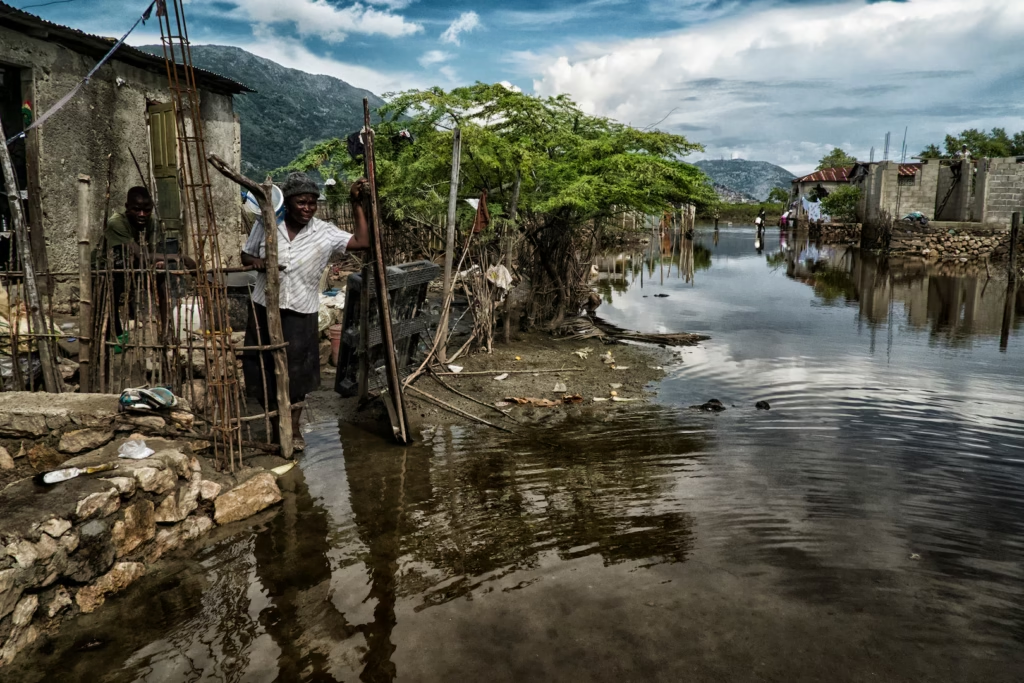
Climate-related disasters often worsen political fragility in states already suffering from weak governance, poverty, corruption, or conflict. Droughts can intensify competition over resources, floods can destroy infrastructure and livelihoods, and food insecurity can fuel political unrest.
Climate change rarely causes wars directly. Instead, it interacts with pre-existing tensions and vulnerabilities, increasing the likelihood of instability and violence.
This “threat multiplier” effect is now visible in multiple regions experiencing environmental stress combined with political fragility.
Water Scarcity and Regional Tensions
One of the most critical security dimensions of climate change involves water scarcity.
Many regions already face severe pressure on freshwater resources due to population growth, urbanization, pollution, and overuse. Climate change intensifies these challenges by altering rainfall patterns, increasing drought frequency, and accelerating desertification.
The Middle East and North Africa are among the world’s most water-stressed regions. Declining water availability increasingly affects agriculture, energy production, economic development, and political stability.
Transboundary river systems such as the Nile, Euphrates, and Tigris have become major geopolitical concerns. Disputes over dams, water access, and resource management are growing more sensitive as climate pressures intensify.
The dispute surrounding Ethiopia’s Grand Ethiopian Renaissance Dam (GERD) demonstrates how water infrastructure projects can become sources of regional geopolitical tension.
Water scarcity may increasingly shape regional diplomacy, migration, and conflict prevention efforts during the coming decades.
Climate Change and Armed Conflict
Researchers continue debating the precise relationship between climate change and armed conflict. However, evidence increasingly shows that environmental stress can contribute to instability under certain political and economic conditions.
In rural societies heavily dependent on agriculture, prolonged droughts and crop failures can devastate local economies, increase displacement, and deepen grievances against governments.
Some analysts argue that severe drought conditions preceding the Syrian uprising contributed indirectly to social unrest by accelerating rural migration, economic hardship, and pressure on urban areas already struggling with governance failures.
Across the Sahel region in Africa, desertification and shrinking grazing lands have intensified competition between farming communities, pastoral groups, and armed organizations.
Climate change also affects insurgencies and extremist movements. Armed groups may exploit environmental crises, state weakness, and resource scarcity to recruit supporters and expand influence.
Environmental instability therefore increasingly overlaps with conflict dynamics in fragile states.
Climate Migration and Global Stability
Climate change is expected to become one of the largest drivers of human displacement during the twenty-first century.
Rising sea levels, droughts, floods, extreme heat, and collapsing agricultural systems are already forcing communities to relocate in vulnerable regions.
Climate migration can occur both internally and across international borders. Large-scale displacement may create humanitarian crises, strain public services, increase social tensions, and reshape political debates around immigration and border security.
Low-lying coastal regions in South Asia, the Pacific Islands, and parts of Africa face particularly severe long-term risks from sea-level rise.
At the same time, climate migration increasingly affects global politics. Migration pressures linked to environmental crises may intensify nationalist politics, border militarization, and anti-immigration movements in receiving countries.
Governments and international organizations are struggling to develop legal frameworks capable of addressing climate-related displacement, as international refugee law does not currently recognize “climate refugees” as a formal legal category.
Food Security and Political Instability
Climate change poses major threats to global food systems.
Rising temperatures, changing rainfall patterns, water shortages, soil degradation, and extreme weather events increasingly affect agricultural productivity across many regions.
Food insecurity has historically contributed to political unrest and instability. Sudden increases in food prices can trigger protests, economic crises, and social tensions.
The 2007–2008 global food crisis and subsequent unrest in several countries demonstrated how vulnerable global food systems are to environmental and economic disruptions.
Climate change may further destabilize food markets by reducing crop yields, disrupting supply chains, and increasing dependence on food imports in vulnerable regions.
Countries heavily reliant on imported food may face growing security concerns if climate-related disruptions affect global agricultural production.
The Arctic and Emerging Geopolitical Competition
Climate change is also transforming global geopolitics through the melting of Arctic ice.
As Arctic ice retreats, new shipping routes, energy reserves, fishing zones, and strategic territories are becoming increasingly accessible.
This has intensified geopolitical competition among Arctic powers including Russia, the United States, China, Canada, and several European states.
Russia has significantly expanded its Arctic military presence, investing in bases, naval infrastructure, and icebreaker fleets to secure strategic influence in the region.
China, despite not being an Arctic state, increasingly views the region as strategically important for trade routes and resource access.
The Arctic may become one of the most important geopolitical competition zones of the coming decades as climate change reshapes global trade and resource dynamics.
Energy Transition and New Power Structures
The global shift away from fossil fuels is transforming international political and economic power structures.
Countries historically dependent on oil and gas exports may face major economic and geopolitical challenges as renewable energy technologies expand.
At the same time, states dominating clean technology industries, rare earth mineral production, battery manufacturing, and renewable energy infrastructure may gain significant strategic advantages.
Competition over lithium, cobalt, rare earth elements, and semiconductor supply chains is already becoming central to geopolitical rivalry between major powers.
China currently dominates many critical mineral processing industries and renewable technology supply chains, raising concerns in Western countries regarding technological dependence.
The energy transition may therefore create entirely new geopolitical alignments and economic dependencies.
Military Adaptation to Climate Change
Climate change increasingly affects military operations and defense planning.
Rising temperatures, extreme weather events, and sea-level rise threaten military infrastructure, naval bases, logistics systems, and operational readiness.
Military organizations around the world are adapting by integrating climate risk assessments into strategic planning.
Navies face challenges from changing Arctic conditions and rising sea levels affecting coastal bases. Armies operating in extreme heat environments face increased logistical and health risks.
Disaster response missions linked to floods, hurricanes, wildfires, and humanitarian crises are also placing growing demands on military forces.
Climate change is therefore altering both the operational environment and strategic priorities of modern militaries.
Climate Change and Global Inequality
One of the most significant aspects of climate change involves its unequal impact across countries and populations.
Developing countries often face the greatest climate vulnerabilities despite contributing least to global greenhouse gas emissions.
Poorer regions typically possess weaker infrastructure, limited adaptation resources, fragile governance systems, and higher dependence on climate-sensitive economic sectors such as agriculture.
This imbalance has become a major source of international political tension during climate negotiations.
Many developing countries argue that wealthy industrialized nations bear historical responsibility for emissions and should provide greater financial support for adaptation and climate mitigation.
Climate justice therefore increasingly shapes international diplomacy and North-South geopolitical relations.
International Institutions and Climate Governance
Global climate governance remains highly fragmented despite growing recognition of climate change as a security issue.
International agreements such as the Paris Climate Accord aim to coordinate emissions reduction efforts, but implementation remains uneven and politically contested.
Geopolitical rivalries often complicate international climate cooperation. Strategic competition between major powers sometimes undermines collective responses to environmental challenges.
At the same time, climate policy increasingly intersects with trade disputes, industrial policy, energy security, and technological competition.
International institutions face growing pressure to integrate climate risks into peacebuilding, humanitarian response, development assistance, and security planning.
The Future of Climate Security
Climate change will likely become one of the defining drivers of global instability during the coming decades.
Environmental crises are expected to intensify pressures related to migration, food security, water access, economic inequality, and political fragility.
At the same time, competition surrounding green technologies, strategic minerals, energy systems, and environmental adaptation may reshape global power dynamics.
The countries most capable of adapting economically, technologically, and politically to climate transformation may gain major strategic advantages.
Meanwhile, vulnerable states facing weak governance and severe environmental pressures may experience increasing instability and humanitarian crises.
Climate security is therefore becoming inseparable from the future of geopolitics itself.
Conclusion
Climate change is no longer simply an environmental challenge. It has become a central issue affecting global security, geopolitical competition, economic stability, and international relations.
Environmental crises increasingly interact with political fragility, migration, resource competition, food insecurity, and armed conflict across multiple regions of the world.
At the same time, the transition toward renewable energy and green technologies is transforming global power structures and creating new forms of geopolitical rivalry.
The security implications of climate change will likely intensify throughout the twenty-first century as environmental pressures grow more severe.
Governments, military institutions, and international organizations now face the challenge of adapting to a world where climate instability increasingly shapes both domestic politics and global strategic competition.
How humanity responds to this challenge may determine not only environmental sustainability, but the future stability of the international order itself.