The US–Israel war against Iran has had a measured impact on China. China’s economy has weathered supply-chain shortages better than those of other Asian and European countries, and American interventionism has benefitted its efforts to promote an alternative world order. In addition, the war in Iran has diverted some American assets from the Pacific and contributed to the depletion of ‘finite levels’ of munitions in the United States.
Nevertheless, analysis of Chinese scholarship and the Chinese Communist Party’s (CCP) official response to the conflict identifies key areas of concern that are likely under discussion internally, including China’s vulnerability to global supply chains, the impact of the war on China’s ability to project itself as a neutral leader of the ‘Global South’ and how US actions may coerce middle powers away from China.
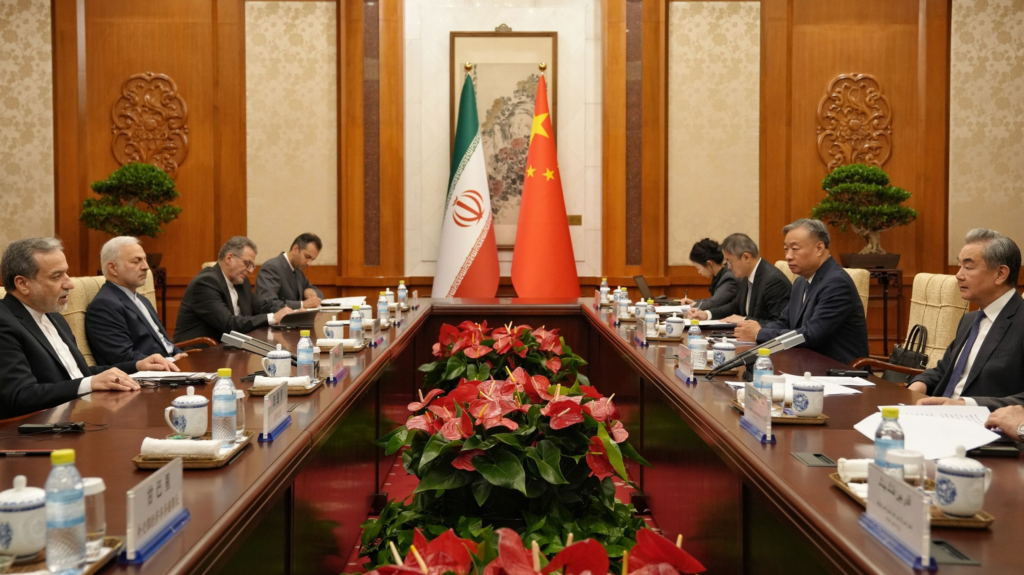
Importantly, however, China’s response to the ongoing Iran war has led Beijing to continue to hedge in a region where it seeks to maintain a neutral, but not equidistant, relationship among all countries. Despite China’s proclaimed success in supporting the normalisation of relations between Iran and Saudi Arabia, China has not shown willingness to play a public and leading mediating role in the aftermath of the two attacks on Iran in 2025 and 2026. Instead, Beijing continues to adhere to its five principles of peaceful co-existence to guide its international relations, while doubling down on efforts to improve China’s self-reliance and resilience.
China’s initial response
In the early days of the Iran war, China’s official response was somewhat less strident in its condemnation of US and Israeli actions when compared to its response to the capture of Nicolás Maduro in January 2026 and other recent conflicts in the Middle East. This was likely down to the unpredictability of the Iran war, as well as concerns that it might challenge China’s strategic ambitions in the Middle East.

On the first day of the conflict (28 February 2026), the Ministry of Foreign Affairs (MFA) said China was ‘highly concerned’ (高度关切) and called for an end to military actions. The following day, China stated US and Israeli actions had violated the United Nations Charter as well as Iran’s sovereignty and territorial integrity but fell short of directly condemning their actions. Instead, the MFA’s statement was only that ‘China firmly opposes and strongly condemns’ the killing of Supreme Leader Sayyid Ali Khamenei. Immediately after the capture of Maduro, however, the MFA said China was ‘deeply shocked and strongly condemns’ US actions. It also used a stronger formulation to express its ‘serious’ (严重) rather than high-level (高度) concern. This was also stronger than China’s statement of ‘deep concern’ (深表) made the day after Hamas attacked Israel on 7 October 2023. Since the early days of the Iran conflict, China has gradually condemned US and Israeli actions more aggressively.
China’s approach to mediation remains based on its five principles of peaceful co-existence: mutual respect for territorial integrity and sovereignty; non-aggression; non-interference in each other’s internal affairs; equality and mutual benefit; and peaceful co-existence. In that regard, taking a measured and cautious response to crises or conflicts is in China’s interest. Nevertheless, the variation between Chinese responses to the different contexts signals that Beijing’s initial response to the ongoing Iran war perhaps reflects some unease within the CCP about how best to respond to events that were not wholly positive for China.
A pragmatic response, with national resilience at its centre
China’s most important concern has been the extent to which the conflict would threaten its economic interests. China is heavily reliant on the region for hydrocarbon supplies, currently sourcing 52% of its imported oil from the Middle East. It also uses economic ties with the region to expand its manufacturing and increasingly high-tech exports.
Two months into the conflict, it appears as though China’s economy has withstood the short-term impact. Driven by a growth in exports and high-tech manufacturing, China’s economy grew by 5% in the first quarter of the year. Factory activity also expanded for a second consecutive month in April, albeit partly driven by buyers purchasing items in anticipation of the war later raising prices.
Despite this economic resilience, there are growing concerns about the economy’s ability to withstand the impact of the war in the medium to long term. This was reflected in the readout of the April Politburo meeting, which said key indicators showed the economy’s ‘powerful resilience and vitality’ but that China will continue to ‘enhance the level of energy and resource security’.
One area of concern has been China’s vulnerability to disruptions in the global supply of key chemical products for agriculture and manufacturing. Approximately 45% of China’s imported methanol and 10% of its polyethylene are sourced from Iran, with the war leading to a 15–30% increase in methanol prices. According to one former National Development and Reform Commission economist, Peng Shaozong, this has caused a ‘significant multiplier effect on China’s manufacturing sector, affecting both upstream and downstream industries’. This exposure has ‘sent shockwaves throughout the real economy…posing a persistent challenge to China’s efforts to stabilize economic growth, prices, and employment’. 56% of China’s sulphur is sourced from the Middle East, which has led to rising fertiliser costs and impacted the spring ploughing season. Reflecting China’s concern about the future impact of supply disruptions, from May it will ban exports of sulphuric acid.
In comparison, there appears to have been less concern about oil shortages. Although China is projected to import almost 80% of oil supplies by 2040 – 52% of which are currently sourced from the Middle East – expanding oil reserves, rapid adoption of electric vehicles and increases in domestic production have thus far appeared resilient to the Strait of Hormuz closure. The CCP’s influence over the domestic economy meant it was able to force private refineries to run at a loss and ban all fuel exports to prevent domestic supply from becoming too low. Nevertheless, there have been warnings that costs in energy-intensive industries had risen by 15–25% and should oil prices reach US$130 per barrel, then China’s ‘high-end manufacturing sectors will face supply and price shocks across all product categories’. Sharing similar concerns, another Chinese economist wrote that both ‘crisis and opportunity coexist’ in this crisis, but a prolonged conflict threatens to raise inflation and suppress China’s domestic consumption.
A reluctant mediator
The concerns about how the ongoing Iran war might impact China’s domestic economy and national resilience have not yet pushed Beijing to play a serious mediating role to end hostilities. Instead, it joined Pakistan on 31 March to propose a five-point plan, calling for: the immediate cessation of hostilities; the start of peace talks as soon as possible; the security of non-military targets; the security of shipping lanes; and the primacy of the UN Charter.
China’s strategy towards the Global South relies on its image as a neutral and unifying leader for all Global South states, as was portrayed by state media when China helped mediate a deal between Saudi Arabia and Iran in March 2023. Iranian strikes on Gulf states, however, have exposed the difficulties China faces in maintaining this image when the interests of its various partners in the region diverge.
China’s Minister of Foreign Affairs Wang Yi indirectly condemned Iran’s strikes in a phone call with Kuwait’s Foreign Minister on 9 March, stating that the ‘sovereignty, security and territorial integrity of Gulf countries must also be fully respected, and any attack on innocent civilians and non-military targets deserves condemnation’. Two days later, however, China abstained from UN Security Council Resolution 2817, which condemned Iranian attacks on Gulf states. This was driven by a desire to balance its ties between the latter and Iran. China’s permanent representative to the UN, Fu Cong, said that although China ‘fully understands the Gulf Arab states’ serious security concerns’, the resolution did not mention US-Israeli strikes on Iran and therefore ‘regretfully’ failed to reflect the ‘conflict in a balanced manner’. At the same time, reports suggest Iran may have used Chinese satellite technology to help strike US bases in Saudi Arabia as well as other Gulf states.

China’s hedging during this conflict is unsurprising to Middle Eastern states who expect the country’s transactional approach and prioritisation of China’s own strategic interests. Nevertheless, the Iran war illustrates how China’s maintenance of its image as a neutral broker and leader of the Global South’s concerns requires careful balancing and management, and how difficult this may become in regions such as the Middle East.
Future considerations
In addition to strengthening national economic-resilience efforts, ongoing debates among Chinese experts and academics suggest that China is drawing lessons from the evolving international order and its place in it. This will have an impact on its ability, or willingness, to play a mediating role in the future.
There appears to be some initial discussion about how China can utilise its bilateral and multilateral relationships to better serve the country’s strategic ambitions under this new global environment. There are proposals to strengthen relationships with Russia as well as African, Central Asian and South American oil-producing states (particularly Brazil) to reduce dependencies on the Middle East. This includes offers to help with their own production facilities. There have also been suggestions to leverage China’s multilateral groupings such as BRICS and the Shanghai Cooperation Organisation to put pressure on ‘major oil-producing countries and consuming nations to maintain global energy market stability’.
Nevertheless, this expanded bilateral and multilateral diplomatic effort will still likely focus on primarily serving Chinese domestic and national interests first, rather than serve as a platform to promote the role of Chinese mediation moving forward. Since 2023, China’s responses to the US–Israel war against Iran, the Iran–Israel conflict, two Thailand–Cambodia conflicts and the Israel–Hamas war show that China’s greatest level of activity was during conflicts or crises between countries within its own neighbourhood. In the Iran conflicts and the Israel–Hamas war, China was slower to respond and did not undertake as many activities in support of a negotiated resolution. The reasons for this could be bureaucratic, about prioritisation or self-presentation. However, if China’s track record is an example of what is to come, then greater pragmatism rather than playing a decisive mediating role is likely for the foreseeable future.
Outlook
The overall economic and geopolitical impact of the Iran war will largely be determined by how long the Strait of Hormuz remains closed as well as its effect on, firstly, Middle Eastern countries; secondly, relationships within the region; and thirdly, relationships between the region and both the US and China. While that remains unclear, China’s focus will be on improving its economic resilience and carrying out diplomatic initiatives to try to court countries away from the US-led order in both the Middle East and elsewhere. It will also be important to watch how China looks to utilise its bilateral and multilateral relationships to influence global energy supplies.