
The Global Institute for Strategic Studies (GISS)
Introduction
Artificial intelligence (AI) is rapidly becoming one of the most transformative forces shaping the future of international security. Once confined to academic research and limited technological applications, AI has evolved into a strategic domain influencing military operations, intelligence gathering, cybersecurity, surveillance systems, economic competition, and geopolitical power balances.
Governments across the world increasingly view artificial intelligence not merely as a technological innovation, but as a critical national security asset capable of redefining military superiority and global influence. The United States, China, Russia, and several regional powers are investing billions of dollars into AI-driven military systems, autonomous weapons, predictive intelligence tools, and cyber capabilities.
This technological race is occurring at a time of growing geopolitical instability, intensifying strategic rivalry, and accelerating military modernization. As a result, artificial intelligence is becoming deeply integrated into global defence strategies and security doctrines.
The implications of this transformation extend far beyond the battlefield. AI is altering how wars are fought, how intelligence is collected, how populations are monitored, and how states compete for technological dominance. At the same time, it raises profound ethical, legal, and strategic concerns regarding accountability, surveillance, autonomous decision-making, and the risk of unintended escalation.
The rise of artificial intelligence may ultimately represent one of the most consequential shifts in global security since the invention of nuclear weapons.
The Global Race for AI Dominance
Artificial intelligence has become central to global strategic competition, particularly between the United States and China. Both countries increasingly perceive AI leadership as essential for economic growth, military modernization, and geopolitical influence.
The United States maintains significant advantages in advanced computing, semiconductor development, research institutions, and private technology companies. American firms such as OpenAI, Google, Microsoft, NVIDIA, and Palantir are leading global AI innovation while increasingly collaborating with defence institutions and intelligence agencies.
China, meanwhile, has adopted a state-driven strategy aimed at becoming the global leader in artificial intelligence by the 2030s. Beijing has integrated AI development into its national security planning, military modernization efforts, and economic policy. Chinese companies such as Baidu, Tencent, Huawei, and SenseTime have become major players in AI research, facial recognition systems, surveillance technologies, and autonomous systems.
Unlike the Cold War nuclear race, the AI competition involves both governments and private corporations simultaneously. Technological breakthroughs achieved by civilian industries often have immediate military applications, blurring the boundaries between commercial innovation and national security.
This dynamic creates a new form of geopolitical rivalry in which technological ecosystems themselves become instruments of strategic power.
AI and Modern Warfare
Artificial intelligence is fundamentally transforming military operations across multiple domains.
Modern militaries increasingly use AI to process massive amounts of battlefield data in real time, improving decision-making speed and operational coordination. AI systems can analyze satellite imagery, identify targets, track troop movements, predict enemy behavior, and optimize logistics far more rapidly than human analysts alone.
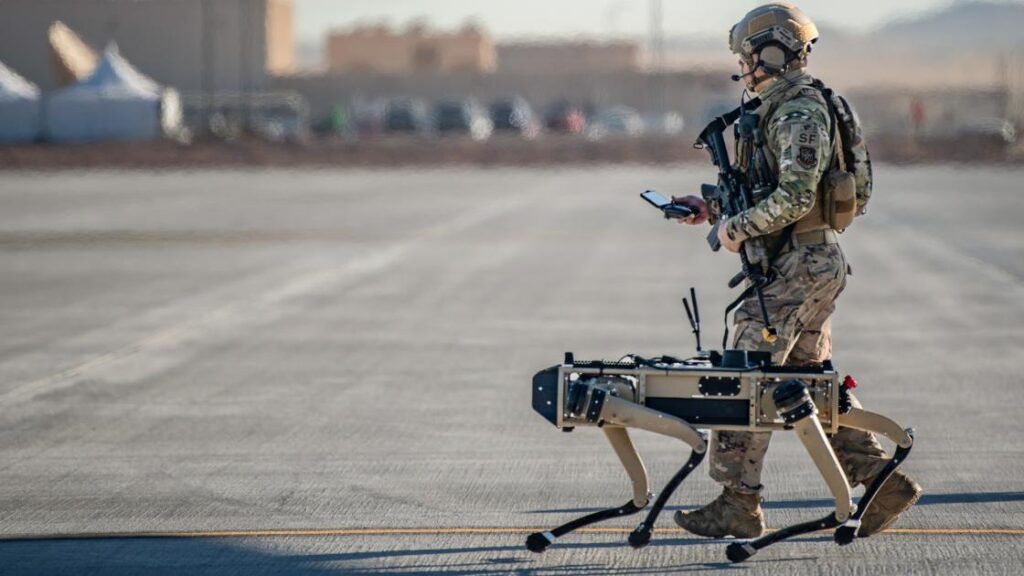
One of the most significant developments is the integration of AI into autonomous weapons systems. These include drones capable of independent navigation, loitering munitions, robotic ground vehicles, and naval drones designed to operate with limited human oversight.
The Ukraine war highlighted how AI-enhanced systems can dramatically increase battlefield effectiveness. Drones integrated with machine learning capabilities improved reconnaissance, artillery targeting, and precision strike operations. Similar technologies are now being rapidly adopted by militaries worldwide.
Artificial intelligence also enhances electronic warfare, missile defence systems, and cyber operations. AI-driven algorithms can detect threats, identify vulnerabilities, and respond to attacks within milliseconds, reducing human reaction time and increasing operational efficiency.
However, this acceleration introduces significant risks. Faster military decision-making may reduce opportunities for diplomatic de-escalation during crises, increasing the danger of rapid escalation between nuclear powers.
Autonomous Weapons and Ethical Dilemmas
The development of autonomous weapons systems has generated intense ethical and legal debates within the international community.
Autonomous weapons are systems capable of selecting and engaging targets without direct human intervention. Proponents argue that such systems could reduce military casualties, improve precision, and minimize human error. Critics warn that delegating lethal decisions to algorithms creates profound moral and humanitarian risks.
One of the central concerns is accountability. If an autonomous weapon commits a war crime or causes civilian casualties, determining legal responsibility becomes highly complex. Responsibility could potentially involve software developers, military commanders, manufacturers, or political leaders.
Another concern involves the possibility of autonomous escalation. AI systems operating at machine speed may respond to perceived threats faster than human operators can intervene, potentially triggering unintended military confrontations.
International organizations and human rights groups have called for regulations or outright bans on fully autonomous lethal weapons. However, major powers remain reluctant to limit technologies they view as strategically essential.
As military competition intensifies, autonomous weapons are likely to become increasingly common despite unresolved ethical questions.
AI and Intelligence Operations
Artificial intelligence is revolutionizing intelligence collection and analysis.
Intelligence agencies increasingly rely on AI to process enormous volumes of digital information, including satellite imagery, intercepted communications, social media activity, financial transactions, and open-source intelligence.
Machine learning systems can identify patterns, detect anomalies, and predict potential threats far more efficiently than traditional intelligence methods. AI-assisted surveillance tools allow governments to monitor populations at unprecedented scales.
Facial recognition technology has become one of the most controversial aspects of AI-driven surveillance. China, in particular, has integrated facial recognition systems into large-scale domestic monitoring programs, especially in regions such as Xinjiang.
Western governments and intelligence agencies are also expanding AI-based surveillance capabilities, although often under different legal frameworks and oversight structures.
The expansion of AI surveillance raises concerns regarding privacy, civil liberties, political repression, and the misuse of data by authoritarian governments.
Cybersecurity and AI-Driven Threats
Artificial intelligence is increasingly central to cybersecurity operations, both offensively and defensively.
AI systems can rapidly identify vulnerabilities in networks, detect malware, and respond to cyberattacks in real time. At the same time, malicious actors are using AI to develop more sophisticated cyber threats, including automated phishing campaigns, adaptive malware, and deepfake technologies.
Deepfakes represent a growing national security concern. AI-generated videos, audio recordings, and fabricated media content can be used to spread disinformation, manipulate public opinion, influence elections, or provoke political instability.
As AI-generated content becomes more realistic, distinguishing authentic information from manipulated media will become increasingly difficult.
Cyber warfare combined with AI-driven disinformation campaigns may become one of the defining security challenges of the coming decades.
AI, Propaganda, and Information Warfare
Artificial intelligence is transforming information warfare and digital propaganda.
States and political actors increasingly use AI-powered algorithms to shape online narratives, manipulate public discourse, and amplify political messaging. Social media platforms, recommendation algorithms, and automated bots can significantly influence public opinion and societal polarization.
Russia, China, and several other governments have integrated digital influence operations into broader geopolitical strategies. These operations often combine cyber tactics, AI-generated content, disinformation campaigns, and psychological operations.
The goal is not always to convince audiences of a single narrative, but rather to create confusion, distrust, and institutional instability.
In democratic societies, AI-enhanced information warfare poses serious risks to electoral systems, social cohesion, and trust in public institutions.
The Economic Dimension of AI Competition
Artificial intelligence is not only a security issue but also a major economic battleground.
Countries leading in AI development are likely to dominate critical industries of the future, including robotics, autonomous transportation, biotechnology, advanced manufacturing, and financial technologies.
Semiconductors have become particularly strategic because advanced AI systems require enormous computational power. This has intensified competition over chip manufacturing, export controls, and technological supply chains.
The United States has imposed restrictions on advanced semiconductor exports to China in an effort to slow Beijing’s AI and military development. China, in turn, is investing heavily in domestic chip production and technological self-sufficiency.
The AI race increasingly intersects with industrial policy, trade disputes, and global economic competition.
AI and Nuclear Stability
One of the most dangerous implications of AI involves nuclear deterrence and strategic stability.
Artificial intelligence may improve early-warning systems, missile tracking, and military decision-making. However, integrating AI into nuclear command-and-control systems also creates risks of miscalculation, technical malfunction, or unintended escalation.
Military planners fear scenarios in which AI systems misinterpret signals or accelerate crisis responses faster than human leaders can assess situations accurately.
The combination of AI, cyber warfare, and nuclear weapons creates unprecedented strategic uncertainty.
Some analysts argue that future arms control agreements may need to address AI systems alongside traditional weapons categories.
The Future Battlefield
The future battlefield will likely be defined by human-machine integration.
Soldiers may increasingly operate alongside autonomous drones, robotic vehicles, AI-assisted targeting systems, and augmented intelligence platforms. Warfare will become more data-driven, networked, and algorithmically managed.
At the same time, asymmetric actors including militias and non-state groups may gain access to increasingly sophisticated AI-enabled technologies, further complicating global security environments.
The spread of AI capabilities could reduce the technological gap between major powers and smaller actors, similar to how drones transformed modern conflict.
Future wars may therefore involve not only states competing militarily, but also networks of autonomous systems interacting across physical, digital, and informational domains simultaneously.
Conclusion
Artificial intelligence is reshaping the foundations of global security. It is transforming military operations, intelligence gathering, cyber warfare, surveillance systems, and geopolitical competition at extraordinary speed.
While AI offers significant advantages in efficiency, precision, and data analysis, it also introduces serious risks related to autonomy, accountability, surveillance, disinformation, and escalation.
The global race for AI dominance increasingly resembles a strategic arms competition, with profound implications for international stability and the future balance of power.
As governments continue integrating AI into military and security systems, the international community faces a critical challenge: how to harness the benefits of artificial intelligence while preventing its most dangerous consequences.
The future of warfare and global order may ultimately depend on how humanity manages this rapidly evolving technological revolution.