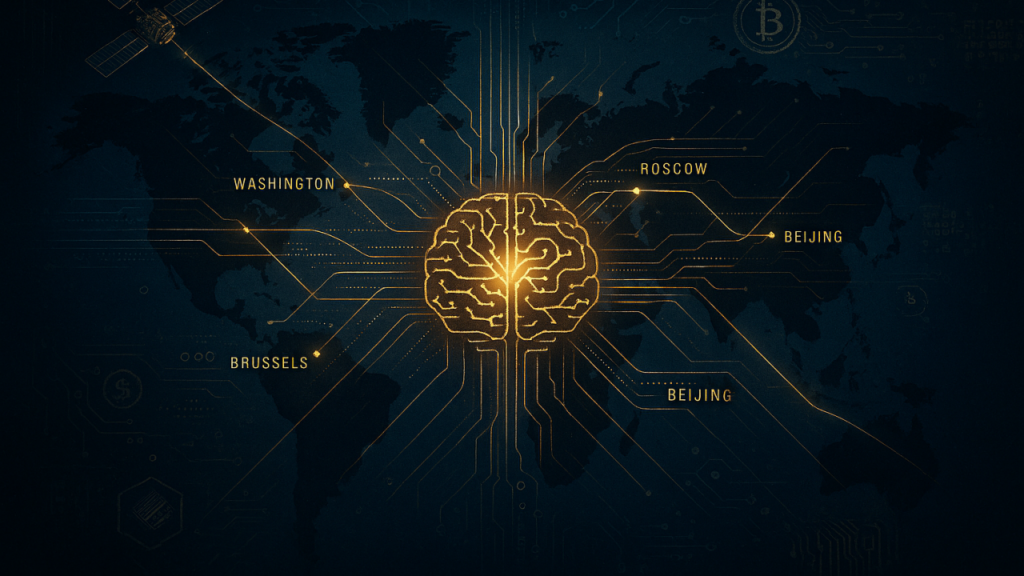
Artificial intelligence is rapidly becoming one of the most transformative forces of the twenty-first century. Once limited to academic research and experimental technologies, AI has evolved into a strategic tool influencing economies, politics, warfare, surveillance, labor markets, media systems, healthcare, finance, and international competition.
The rise of AI represents not only a technological revolution, but also a profound political and social transformation.
Unlike previous industrial revolutions, artificial intelligence directly affects decision-making, information systems, automation, human behavior, and even the production of knowledge itself. AI systems are already shaping how societies communicate, consume information, conduct warfare, manage economies, and exercise political power.
At the same time, artificial intelligence introduces enormous risks involving surveillance, misinformation, labor displacement, algorithmic bias, cybersecurity threats, and concentration of technological power in the hands of governments and corporations.
The future global order may increasingly depend on which countries and institutions successfully develop, regulate, and control artificial intelligence technologies.
The Global AI Race
Artificial intelligence has become one of the primary arenas of strategic competition between major global powers.
The United States and China currently dominate the global AI landscape, investing heavily in research, semiconductor manufacturing, data infrastructure, military applications, and advanced computing systems.
Governments increasingly view AI leadership as essential for economic competitiveness, military superiority, and geopolitical influence.
This competition extends far beyond technology itself. It involves control over data, computing infrastructure, talent, supply chains, semiconductor production, and digital ecosystems.
Countries unable to participate effectively in the AI revolution risk becoming technologically dependent on more advanced powers.
As a result, artificial intelligence is increasingly treated as a strategic national asset comparable to nuclear technology or energy security.
The United States and Technological Dominance
The United States remains the world’s leading AI innovation center due to its dominance in advanced research institutions, private technology companies, venture capital ecosystems, and semiconductor design.
Companies such as OpenAI, Google, Microsoft, NVIDIA, Meta, and Amazon are driving major breakthroughs in machine learning, generative AI, cloud computing, and advanced language models.
The close relationship between Silicon Valley and U.S. national security institutions has also intensified.
American policymakers increasingly recognize that maintaining technological leadership in AI is central to preserving global geopolitical influence.
At the same time, the U.S. faces growing concerns regarding regulation, misinformation, labor disruption, and ethical governance of AI systems.
Balancing innovation with democratic oversight has become one of the central challenges of American AI policy.
China’s AI Ambitions
China has emerged as the primary global competitor to the United States in artificial intelligence.
Beijing considers AI development a strategic national priority directly connected to economic modernization, military strength, and political control.
The Chinese government has invested heavily in facial recognition systems, surveillance technologies, autonomous systems, smart cities, and AI-driven industrial development.
Unlike Western democracies, China integrates AI development closely with centralized state planning and large-scale data collection systems.
This model provides significant advantages in areas such as surveillance infrastructure, predictive analytics, and public monitoring technologies.
China also seeks to reduce dependence on Western semiconductor technologies and build self-sufficient AI ecosystems.
The global competition between the United States and China increasingly revolves around technological supremacy in artificial intelligence.
Artificial Intelligence and Warfare
Artificial intelligence is fundamentally transforming modern warfare.
Military institutions worldwide are integrating AI into autonomous drones, surveillance systems, cyber operations, battlefield intelligence, logistics, missile defense, and decision-support systems.
AI technologies enable faster data analysis, real-time threat assessment, automated targeting, and predictive military planning.
Autonomous weapons systems capable of identifying and engaging targets without direct human control are becoming increasingly sophisticated.
This raises major ethical and strategic concerns regarding accountability, escalation risks, and the future role of human decision-making in warfare.
The combination of AI, drones, cyber warfare, and satellite technologies may redefine military conflict during the coming decades.
Future wars could involve highly automated battlefields where algorithms play central roles in operational decisions.
Surveillance, Control, and Digital Authoritarianism
Artificial intelligence has dramatically expanded the capabilities of state surveillance systems.
Governments increasingly use AI-powered facial recognition, predictive policing, biometric monitoring, behavioral analysis, and mass data collection to monitor populations.
These technologies are particularly attractive to authoritarian governments seeking stronger social control.
Digital authoritarianism allows states to suppress dissent, track opposition movements, censor information, and manage public behavior on an unprecedented scale.
AI-driven surveillance systems can identify political activists, monitor online communications, and predict social unrest.
At the same time, even democratic governments face growing debates regarding privacy, security, and the acceptable limits of state monitoring.
The expansion of AI surveillance technologies may become one of the defining human rights challenges of the century.
AI, Media, and Disinformation
Artificial intelligence is transforming global information systems.
Generative AI tools can now produce realistic text, images, videos, and audio content at massive scale and low cost.
While these technologies create significant opportunities for education, creativity, and communication, they also introduce major risks involving misinformation, propaganda, and manipulation.
Deepfake technologies increasingly blur the line between authentic and fabricated content.
Political actors, governments, extremist groups, and criminal organizations may use AI-generated media to influence elections, spread false narratives, manipulate public opinion, or destabilize societies.
The information environment is becoming increasingly difficult to verify.
Journalism, democratic institutions, and public trust may face unprecedented challenges in distinguishing truth from synthetic manipulation.
Economic Transformation and Labor Markets
Artificial intelligence is expected to transform labor markets globally.
Automation technologies may significantly increase productivity while simultaneously disrupting traditional employment sectors.
Industries involving repetitive tasks, administrative work, transportation, customer service, manufacturing, and data processing are particularly vulnerable to automation.
At the same time, AI may create entirely new industries and forms of employment requiring advanced technical and analytical skills.
The economic impact of AI will likely vary significantly between countries depending on education systems, infrastructure, economic diversification, and regulatory policies.
One of the major global challenges will involve managing labor displacement and economic inequality during the AI transition.
Without effective adaptation policies, AI-driven economic transformation could intensify social instability and inequality.
AI and Global Economic Power
Artificial intelligence may become one of the primary determinants of future economic power.
Countries leading AI innovation are likely to dominate emerging industries involving robotics, healthcare, defense, finance, logistics, and digital infrastructure.
Access to advanced semiconductors, computing power, data infrastructure, and AI talent will increasingly shape economic competitiveness.
The semiconductor industry has therefore become strategically critical.
Competition over chip manufacturing, export controls, and supply chains now occupies a central position within geopolitical rivalries.
The future global economy may become increasingly divided between countries capable of developing advanced AI systems and those dependent on foreign technologies.
Ethical Challenges and Algorithmic Bias
AI systems are not politically or socially neutral.
Algorithms are shaped by training data, institutional priorities, cultural assumptions, and human design choices.
This creates risks involving algorithmic bias, discrimination, and unequal treatment.
AI systems used in policing, hiring, banking, healthcare, immigration, and judicial systems may reinforce existing inequalities if poorly designed or insufficiently regulated.
Questions surrounding transparency, accountability, fairness, and human oversight are becoming increasingly urgent.
Who controls AI systems? Who is responsible when algorithms make harmful decisions? How can societies ensure transparency in highly complex systems?
These questions remain largely unresolved.
Artificial General Intelligence and Existential Risks
Some researchers and technology leaders believe artificial intelligence may eventually surpass human cognitive capabilities in many domains.
The possibility of Artificial General Intelligence (AGI) — AI systems capable of broad reasoning and autonomous learning comparable to or exceeding human intelligence — has generated intense debate.
Supporters argue AGI could revolutionize science, medicine, energy, and economic productivity.
Critics warn that highly advanced AI systems may create serious risks if human control mechanisms fail.
Concerns involve autonomous decision-making, concentration of power, military misuse, economic disruption, and long-term existential risks.
Although AGI remains uncertain and speculative, debates surrounding AI safety and governance are becoming increasingly important globally.
Global Governance and AI Regulation
Governments and international organizations are struggling to regulate artificial intelligence effectively.
Technological innovation often advances faster than legal and political systems can respond.
Different countries also adopt very different regulatory approaches. The European Union emphasizes privacy, transparency, and ethical oversight. The United States prioritizes innovation and private-sector leadership. China integrates AI governance within centralized state control frameworks.
The absence of global regulatory standards creates significant uncertainty.
International cooperation may become essential for addressing risks involving autonomous weapons, disinformation, surveillance, cybersecurity, and AI safety.
However, geopolitical rivalry may complicate efforts to establish common global rules.
AI and Human Identity
Artificial intelligence is not only transforming economies and politics — it is also reshaping human identity and social interaction.
AI increasingly influences education, relationships, creativity, communication, and access to knowledge.
Questions surrounding authorship, originality, creativity, and even consciousness are becoming more relevant as generative AI systems grow more sophisticated.
Human societies may need to reconsider the role of work, learning, and human decision-making in increasingly automated environments.
The psychological and cultural effects of widespread AI integration remain deeply uncertain.
Artificial intelligence is becoming one of the most powerful forces shaping the future of global politics, economics, warfare, and society.
The global AI race increasingly defines geopolitical competition between major powers, particularly the United States and China. At the same time, AI technologies are transforming military systems, labor markets, surveillance infrastructures, information ecosystems, and economic structures worldwide.
While artificial intelligence offers extraordinary opportunities for innovation and human advancement, it also introduces profound risks involving authoritarianism, inequality, disinformation, automation, and concentration of power.
The future impact of AI will depend not only on technological progress itself, but also on political choices, regulatory systems, ethical governance, and international cooperation.
Artificial intelligence may ultimately reshape the balance of global power more profoundly than any technological revolution since the industrial age.