Migration has become one of the most politically explosive and strategically important issues shaping Europe, the United States, and Western democracies in the twenty-first century. What was once primarily viewed as a humanitarian, economic, or labor issue has evolved into a central force reshaping elections, national identities, security policies, political discourse, and international relations.
Wars, climate change, economic inequality, authoritarian repression, demographic pressures, and global instability have accelerated migration flows across multiple regions. At the same time, the political response to migration has transformed Western politics, contributing to the rise of far-right parties, nationalist movements, anti-immigration rhetoric, and deep societal polarization.
The migration debate now influences nearly every major political issue in Europe and North America, including border security, labor markets, social welfare systems, cultural identity, terrorism concerns, housing crises, and democratic stability.
As migration pressures continue growing globally, Western governments face an increasingly difficult challenge: balancing humanitarian obligations, economic needs, national security concerns, and rising domestic political tensions.
The future of migration policy may become one of the defining political struggles shaping Europe, the United States, and liberal democracies during the coming decades.
The Global Drivers of Migration
Modern migration is driven by multiple interconnected crises occurring simultaneously across the world. Armed conflicts in Syria, Ukraine, Sudan, Afghanistan, Gaza, and other regions have displaced millions of people. Political repression, authoritarian governments, and human rights abuses continue forcing individuals to flee their countries.
Economic inequality also plays a major role. Large income gaps between developing and developed countries encourage migration toward Europe and North America in search of employment, stability, and better living conditions.
Climate change is increasingly becoming a migration driver as droughts, environmental degradation, water shortages, and natural disasters disrupt livelihoods and agricultural systems.
Population growth in parts of Africa and the Middle East is expected to intensify migration pressures further in the coming decades.
Migration is therefore not a temporary phenomenon, but part of a long-term structural transformation affecting global demographics and international politics.
Europe and the Post-2015 Migration Crisis
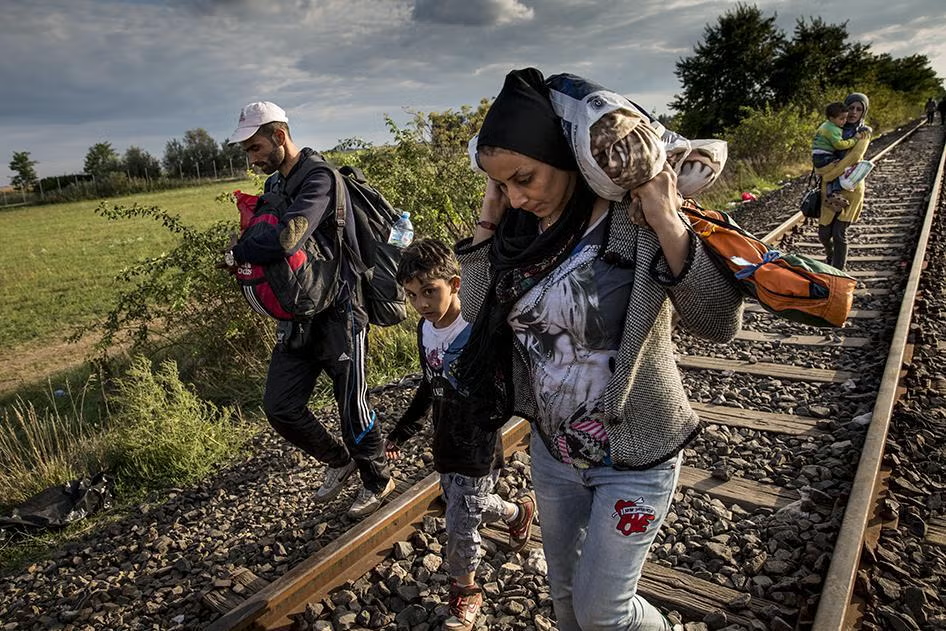
The migration crisis that intensified in 2015 profoundly transformed European politics. Millions of refugees and migrants — particularly from Syria, Iraq, Afghanistan, and parts of Africa — entered Europe through Mediterranean and Balkan routes.
Germany initially adopted an open-door policy under Chancellor Angela Merkel, while other European countries implemented stricter border controls and anti-immigration measures.
The crisis exposed deep divisions within the European Union regarding burden-sharing, border security, asylum systems, and national sovereignty.
It also accelerated the rise of nationalist and anti-immigration political movements across Europe.
Migration became not only a humanitarian issue, but also a symbol within broader cultural and political conflicts involving globalization, identity, multiculturalism, and trust in political elites.
The Rise of Far-Right Politics in Europe
Far-right parties have expanded significantly across Europe during the past decade. Political movements emphasizing nationalism, anti-immigration policies, border security, cultural identity, and skepticism toward the European Union have gained electoral influence in countries including France, Germany, Italy, the Netherlands, Sweden, Austria, and Hungary.
These parties often portray migration as a threat to national identity, public safety, economic stability, and social cohesion.
Migration debates increasingly dominate election campaigns and public discourse across Europe.
In some cases, mainstream political parties have also adopted stricter immigration rhetoric in response to public pressure and electoral competition.
The normalization of anti-immigration narratives has significantly reshaped European politics.
Migration and Political Polarization in the United States
Migration has also become one of the most polarizing political issues in the United States. Debates surrounding the U.S.-Mexico border, asylum systems, undocumented immigration, refugee policies, and border wall construction have deeply divided American politics.
Immigration increasingly intersects with broader political conflicts involving nationalism, race, economic insecurity, and cultural identity.
The issue played a central role in Donald Trump’s political rise and continues shaping Republican and Democratic political strategies.
At the same time, the United States remains heavily dependent on immigrant labor in sectors such as agriculture, healthcare, construction, and technology.
This creates a contradiction between economic realities and political narratives surrounding migration.
The American immigration debate increasingly reflects broader anxieties about globalization, demographic change, and political polarization.
Britain After Brexit
Migration was one of the central issues driving the Brexit referendum in the United Kingdom. Concerns regarding European Union freedom of movement, border control, national sovereignty, and immigration levels played major roles in public support for leaving the EU.
However, post-Brexit Britain continues facing significant labor shortages in healthcare, agriculture, transportation, and service sectors.
The British government now faces the challenge of reducing irregular migration while maintaining economic stability and labor market needs.
At the same time, small boat crossings across the English Channel have become highly politicized and symbolic within British domestic politics.
Migration continues shaping debates regarding British identity, sovereignty, and the future direction of the country after Brexit.
Security Concerns and Terrorism
Migration debates are often linked to security concerns and fears surrounding terrorism. Although the vast majority of migrants and refugees are not involved in violence or extremism, several terrorist attacks in Europe intensified public fears regarding border security and integration.
Far-right political movements frequently use security narratives to justify stricter immigration policies and surveillance measures.
Governments increasingly emphasize border enforcement, intelligence cooperation, deportation systems, and counterterrorism policies in migration management.
However, security-focused approaches sometimes risk stigmatizing entire communities and increasing social tensions.
Balancing security concerns with human rights protections remains a major challenge for democratic governments.
The Economic Debate Around Migration
Migration has both economic benefits and political controversies. Many Western economies rely heavily on migrant labor to address aging populations, workforce shortages, and declining birth rates.
Immigrants contribute significantly to healthcare systems, agriculture, construction, logistics, technology, and service industries.
At the same time, migration can place pressure on housing markets, social services, infrastructure, and public spending — particularly during periods of rapid population growth.
Economic frustrations related to inflation, housing shortages, and inequality are often redirected politically toward migration issues.
This creates fertile conditions for populist narratives linking immigration to economic decline or social instability.
The economic impact of migration therefore remains deeply politicized.
Integration, Identity, and Social Cohesion
One of the most difficult challenges surrounding migration involves integration and social cohesion. Questions regarding cultural identity, language, religion, education, and national belonging increasingly shape political debates in Western societies.
Some critics argue that multicultural policies have failed to integrate immigrant communities effectively, while others warn that exclusionary nationalism threatens democratic pluralism and minority rights.
Migration debates often reflect broader anxieties regarding cultural change and demographic transformation.
Second-generation immigrant communities frequently face discrimination, economic marginalization, and identity struggles despite being born within Western societies.
Successful integration policies may become essential for long-term democratic stability and social cohesion.
Media, Social Media, and Migration Narratives
Media coverage plays a major role in shaping public perceptions of migration. Traditional media, social media platforms, political campaigns, and online disinformation networks all influence migration narratives.
Emotionally charged images, viral misinformation, isolated criminal incidents, and political propaganda often amplify public fears and polarization.
Far-right groups increasingly use digital platforms to spread anti-immigration narratives and conspiracy theories regarding demographic replacement or cultural threats.
At the same time, humanitarian organizations use media to highlight refugee suffering and human rights concerns.
The migration debate increasingly unfolds within fragmented digital information environments where emotional narratives often overpower nuanced analysis.
Climate Migration and the Future
Climate change may dramatically increase migration pressures during the coming decades. Rising temperatures, droughts, sea-level rise, desertification, and environmental disasters could displace millions of people globally.
Regions already facing economic instability and weak governance may experience intensified migration flows toward Europe and North America.
Climate migration could become one of the largest geopolitical and humanitarian challenges of the twenty-first century.
Western governments are largely unprepared for the scale of future displacement potentially linked to environmental collapse.
The intersection between climate change, migration, and political instability may become increasingly central to global security discussions.
Human Rights and International Law
Migration also raises major legal and ethical questions. International refugee law protects individuals fleeing war, persecution, and human rights abuses. However, governments increasingly seek stricter border controls and asylum restrictions.
This creates tensions between humanitarian obligations and domestic political pressures.
Human rights organizations frequently criticize detention centers, deportation practices, pushbacks at borders, and unsafe migration routes.
At the same time, governments argue that uncontrolled migration undermines border sovereignty and public confidence.
The future of asylum systems and refugee protections remains uncertain as migration pressures increase globally.
The Future of Western Politics
Migration is likely to remain one of the most influential political issues shaping Europe, the United States, and Western democracies for decades.
Demographic trends, labor shortages, geopolitical instability, and climate change suggest migration pressures will continue growing rather than declining.
At the same time, public anxiety surrounding identity, security, and economic stability may continue fueling nationalist and far-right movements.
The political future of Western democracies may increasingly depend on their ability to manage migration effectively while preserving democratic values, social cohesion, and economic stability.
Failure to address these tensions could intensify political polarization and democratic instability across the West.
Migration has become far more than a humanitarian or border issue. It now sits at the center of political, economic, cultural, and geopolitical struggles shaping Europe, the United States, and the broader Western world.
Wars, inequality, climate change, demographic pressures, and global instability continue driving migration flows, while domestic political reactions increasingly fuel polarization and the rise of far-right politics.
Western societies face a difficult balancing act between border security, economic realities, humanitarian responsibilities, and social cohesion.
The future of migration policy may ultimately determine not only the stability of Western democracies, but also the broader direction of globalization, human rights, and international politics during the twenty-first century.