The Global Institute for Strategic Studies (GISS)
Transnational organized crime has evolved into one of the most significant and complex global security threats of the twenty-first century. No longer confined to isolated criminal groups operating within national borders, modern organized crime networks now function as highly adaptive transnational systems interconnected with politics, war economies, corruption, cybercrime, human trafficking, narcotics production, arms smuggling, money laundering, and illicit financial markets.
These networks increasingly operate across fragile states, conflict zones, financial centers, digital platforms, and global trade routes. In many regions, organized crime has become deeply intertwined with political elites, armed groups, intelligence actors, militias, and corrupt state institutions.
The globalization of finance, communication technologies, transportation systems, and digital economies has enabled criminal organizations to expand operations on an unprecedented scale. At the same time, wars, weak governance, sanctions, economic collapse, and geopolitical instability have created fertile environments for criminal economies to flourish.
Today, organized crime is no longer simply a law enforcement issue. It directly affects global security, democratic institutions, economic stability, migration flows, environmental destruction, and international politics.
In some countries, criminal networks now possess financial resources, military capabilities, and political influence rivaling those of states themselves.
The Evolution of Modern Organized Crime
Traditional organized crime structures historically revolved around hierarchical groups involved in activities such as extortion, smuggling, gambling, and local corruption.
However, modern transnational organized crime has evolved into highly flexible and decentralized networks operating across multiple continents and sectors simultaneously.
Contemporary criminal organizations often cooperate across ideological, ethnic, and political boundaries when financial interests align. Drug cartels, cybercriminals, arms traffickers, money launderers, human smugglers, and corrupt financial intermediaries increasingly form interconnected global ecosystems.
The digital revolution significantly accelerated this transformation. Cryptocurrencies, encrypted communications, online marketplaces, offshore banking systems, and cyber technologies now enable criminal groups to move money, coordinate operations, and evade authorities more efficiently than ever before.
Modern organized crime increasingly resembles multinational business networks operating within globalized economic systems.
Organized Crime and Fragile States
Fragile and conflict-affected states often provide ideal environments for organized criminal networks.
Weak institutions, corruption, economic collapse, poor border control, and ongoing violence create conditions where illicit economies become deeply embedded within political and social structures.
In many conflict zones, criminal economies finance armed groups, militias, insurgencies, and political actors. Smuggling networks may become central sources of income for local power structures.
Countries experiencing war or political instability frequently witness the emergence of hybrid systems where state actors, militias, businessmen, intelligence agencies, and criminal organizations operate together within overlapping networks.
In some cases, governments themselves become partially dependent on illicit economies for survival under sanctions or economic pressure.
This convergence between organized crime and state structures significantly complicates international security and anti-corruption efforts.
Drug Trafficking and Narco-Politics
Drug trafficking remains one of the largest components of global organized crime.
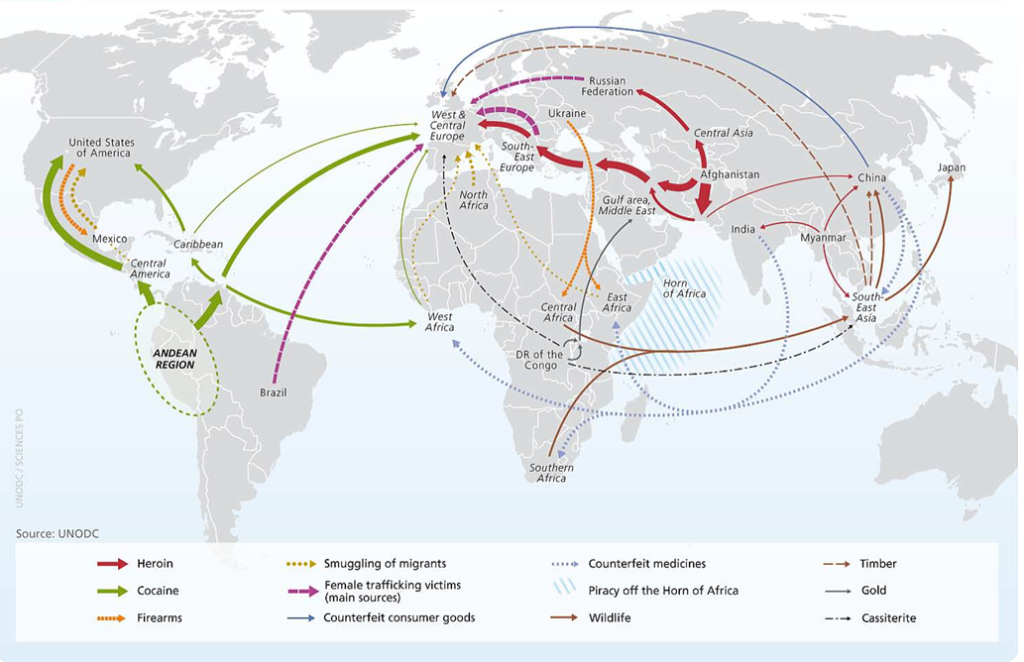
International narcotics markets involving cocaine, heroin, methamphetamine, synthetic drugs, and Captagon generate hundreds of billions of dollars annually.
Latin American cartels continue dominating global cocaine trafficking networks, while synthetic drug production has expanded rapidly across the Middle East and Asia.
The rise of Captagon production in Syria demonstrated how narcotics economies can become integrated into conflict zones and political systems. Drug production networks reportedly involved militia structures, businessmen, security actors, and transnational smuggling routes extending across the Middle East and Europe.
In several regions, narcotics trafficking has profoundly influenced politics and governance. Criminal organizations increasingly infiltrate state institutions, corrupt law enforcement agencies, finance political campaigns, and intimidate journalists and judges.
The relationship between narcotics economies and political power has become a defining feature of modern organized crime.
Human Trafficking and Migration Networks
Human trafficking represents one of the most profitable and abusive sectors of transnational organized crime.
Criminal networks exploit vulnerable populations through forced labor, sexual exploitation, illegal migration systems, debt bondage, and modern slavery.
Conflict zones, economic collapse, climate crises, and political instability significantly increase vulnerability to trafficking networks.
Smuggling routes connecting Africa, the Middle East, Latin America, and Europe have become major criminal economies generating billions of dollars annually.
Human trafficking organizations increasingly use digital platforms, encrypted communication tools, and sophisticated financial systems to coordinate operations internationally.
At the same time, migration restrictions and border militarization may unintentionally strengthen smuggling networks by increasing demand for illegal migration routes.
The human cost of these criminal systems remains devastating, particularly for refugees, women, and children.
Cybercrime and the Digital Criminal Economy
Cybercrime has become one of the fastest-growing sectors of global organized crime.
Ransomware attacks, financial fraud, cryptocurrency theft, data breaches, identity theft, online scams, and digital extortion now generate enormous illicit profits.
Unlike traditional criminal operations requiring physical infrastructure, cybercrime networks can operate globally with relatively low costs and high anonymity.
Some cybercriminal groups function similarly to multinational corporations, complete with specialized teams, customer support systems, and profit-sharing arrangements.
Cryptocurrencies and decentralized finance systems have further complicated law enforcement efforts by enabling rapid cross-border financial transfers outside traditional banking oversight.
State-sponsored cyber actors also increasingly overlap with criminal networks. In some cases, governments tolerate or indirectly cooperate with cybercriminal organizations aligned with national strategic interests.
The line between cybercrime, espionage, and hybrid warfare is becoming increasingly blurred.
Money Laundering and Offshore Financial Systems
Modern organized crime depends heavily on global financial systems capable of concealing illicit wealth.
Money laundering networks use shell companies, offshore tax havens, real estate markets, cryptocurrency systems, trade-based laundering schemes, and corrupt financial institutions to hide criminal proceeds.
Major global financial centers often unintentionally facilitate illicit financial flows through weak oversight, regulatory loopholes, and anonymous ownership structures.
Corruption and money laundering networks frequently involve lawyers, accountants, bankers, real estate brokers, and financial consultants operating within legitimate economic sectors.
The Panama Papers, Paradise Papers, and multiple investigative journalism projects exposed how political elites, oligarchs, and criminal actors exploit offshore financial systems to conceal wealth and evade accountability.
Illicit financial flows significantly undermine global economic transparency and governance.
Organized Crime and Armed Conflict
The relationship between organized crime and armed conflict has become increasingly interconnected.
Wars create opportunities for smuggling, black markets, weapons trafficking, resource exploitation, and illicit financing.
Armed groups often rely on criminal economies to sustain operations. In some cases, insurgencies gradually transform into profit-driven criminal enterprises.
Conflict zones involving weak governance frequently become hubs for trafficking networks involving oil, minerals, antiquities, narcotics, weapons, and people.
In Syria, Libya, Afghanistan, parts of Africa, and Latin America, criminal economies became deeply integrated into wartime political structures.
The persistence of illicit economies after conflicts end may continue destabilizing post-war reconstruction and state-building efforts for years.
Environmental Crime and Resource Exploitation
Environmental crime has become a major component of global organized crime.
Illegal logging, wildlife trafficking, illegal fishing, toxic waste dumping, and illicit mining operations generate enormous profits while causing severe environmental destruction.
Criminal organizations increasingly exploit natural resources in regions with weak governance and corruption.
Illegal mining operations involving gold, rare earth minerals, and conflict resources often finance armed groups and fuel violence.
Environmental crime also intersects with global supply chains, corporate corruption, and transnational financial systems.
As competition over natural resources intensifies due to climate change and energy transitions, environmental crime may become even more strategically significant.
Organized Crime and Political Corruption
Corruption is one of the central mechanisms enabling organized crime to operate globally.
Criminal networks rely heavily on bribery, political protection, institutional infiltration, and regulatory manipulation to secure operational freedom.
In some countries, criminal organizations effectively capture parts of the state apparatus through alliances with politicians, security officials, judges, and business elites.
This phenomenon is often described as “state capture,” where public institutions increasingly serve private criminal interests rather than public governance.
Journalists, anti-corruption investigators, judges, and civil society activists investigating these networks frequently face intimidation, imprisonment, violence, or assassination.
The convergence between organized crime and political systems represents one of the greatest threats to democratic governance worldwide.
The Role of Investigative Journalism
Investigative journalism plays a critical role in exposing organized crime networks and illicit financial systems.
Cross-border investigative collaborations such as OCCRP, ICIJ, and GIJN have significantly expanded the ability of journalists to investigate complex transnational criminal systems.
Investigative reporters increasingly use leaked financial data, satellite imagery, open-source intelligence, corporate records, and digital forensic tools to expose corruption, sanctions evasion, war economies, and organized crime structures.
However, journalists investigating organized crime often face severe risks including surveillance, legal harassment, imprisonment, and assassination.
The murder of investigative journalists in multiple countries demonstrates the dangerous intersection between organized crime and attacks on press freedom.
Independent journalism remains one of the most important mechanisms for public accountability in confronting transnational criminal systems.
International Responses and Challenges
Governments and international institutions continue struggling to effectively combat transnational organized crime.
The globalized nature of criminal networks often exceeds the capacity of national law enforcement systems operating within limited jurisdictions.
International cooperation involving intelligence sharing, financial regulation, anti-money laundering systems, sanctions enforcement, and cross-border investigations remains inconsistent.
At the same time, geopolitical rivalries sometimes undermine cooperation against organized crime, particularly when criminal networks overlap with strategic political interests.
Technological innovation also allows criminal groups to adapt rapidly to enforcement efforts.
The fight against organized crime increasingly requires global coordination across financial systems, cybersecurity, border control, judicial reform, and anti-corruption mechanisms.
Conclusion
Transnational organized crime has evolved into one of the defining global security challenges of the modern era.
Criminal networks increasingly intersect with politics, conflict, finance, cyber systems, migration, and global trade in ways that profoundly affect international stability and governance.
The rise of digital technologies, fragile states, corruption, and geopolitical instability has enabled organized crime to expand far beyond traditional criminal structures.
In many regions, criminal economies now operate alongside political systems, armed groups, and state institutions themselves.
Combating these networks requires far more than traditional law enforcement responses. It demands international cooperation, financial transparency, anti-corruption reforms, strong institutions, independent journalism, and accountability mechanisms capable of addressing the globalized nature of modern illicit economies.
The future of global security may depend significantly on whether governments and societies can successfully confront the growing power of transnational organized crime.