
The Global Institute for Strategic Studies (GISS)
Introduction
Over the past decade, drones have transformed from limited reconnaissance tools into central pillars of modern warfare. What was once considered a specialized military capability possessed primarily by major powers has evolved into one of the defining features of contemporary conflict. Today, unmanned aerial vehicles (UAVs) are used not only by advanced state militaries, but also by militias, insurgent groups, proxy forces, and even criminal networks across multiple regions of the world.
The wars in Ukraine, Gaza, Sudan, Libya, Nagorno-Karabakh, and the Red Sea have demonstrated that drones are no longer supplementary systems operating on the margins of battlefields. Instead, they have become strategic instruments capable of reshaping military doctrines, altering battlefield economics, and changing the balance between conventional armies and irregular actors. In many modern conflicts, low-cost drones have proven capable of destroying tanks, disrupting naval operations, targeting critical infrastructure, and undermining the strategic advantages traditionally enjoyed by technologically superior states.
This transformation reflects a broader shift in the nature of warfare itself. Military power is increasingly defined not only by the possession of advanced fighter jets, armored divisions, or expensive missile systems, but also by adaptability, technological innovation, and the ability to integrate unmanned systems into real-time battlefield operations. As drone technologies continue to evolve alongside artificial intelligence and electronic warfare capabilities, they are likely to shape the future of conflict for decades to come.
The Evolution of Drone Warfare
The origins of military drones can be traced back to reconnaissance missions designed to minimize pilot risk and enhance battlefield surveillance. During the 1990s and early 2000s, the United States pioneered modern drone warfare through systems such as the MQ-1 Predator, initially developed for intelligence gathering before being weaponized for targeted operations in Afghanistan, Iraq, Yemen, Somalia, and Pakistan during the “War on Terror.”
At that stage, drone warfare remained highly centralized and technologically exclusive. Only a handful of states possessed the satellite infrastructure, secure communications systems, and precision-guided capabilities necessary to operate advanced UAVs. Drones were expensive, sophisticated systems tied to the strategic capabilities of major military powers.
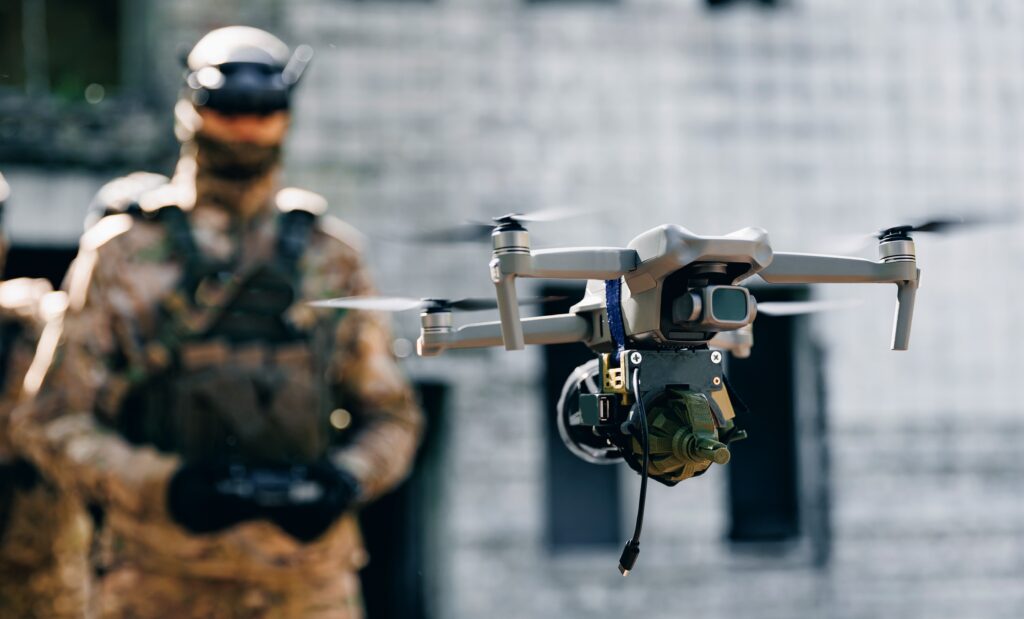
However, rapid technological diffusion dramatically altered this equation. The expansion of commercial drone markets, declining production costs, widespread access to GPS navigation systems, and the availability of high-resolution cameras transformed drones into accessible technologies with both civilian and military applications. Commercial quadcopters originally designed for photography and recreation began appearing on battlefields, modified to carry explosives, conduct reconnaissance, or direct artillery fire.
This shift effectively democratized air power. Capabilities once monopolized by advanced states became available to smaller armies and non-state actors, fundamentally reshaping modern warfare.
Ukraine and the Largest Drone Battlefield in History
The Russia–Ukraine war has become the defining case study of modern drone warfare. Since the beginning of the conflict, both sides have deployed drones on an unprecedented scale, transforming the battlefield into a laboratory for unmanned military innovation.
Ukraine relied heavily on a combination of Turkish Bayraktar TB2 drones, commercial quadcopters, FPV (First Person View) drones, maritime drones, and long-range strike UAVs. Russia, meanwhile, integrated reconnaissance drones, Lancet loitering munitions, and Iranian-made Shahed drones into its operational strategy. The war demonstrated how drones could simultaneously fulfill multiple military roles: reconnaissance, artillery correction, precision strikes, psychological warfare, naval attacks, infrastructure sabotage, and long-range strategic operations.
One of the most significant developments in Ukraine has been the rise of FPV drones. These relatively inexpensive systems, often assembled from commercial components, became capable of destroying tanks, armored vehicles, radar systems, and artillery pieces worth millions of dollars. This transformed battlefield economics. A drone costing several hundred dollars could eliminate military assets costing millions, challenging traditional assumptions about military superiority and force protection.
The implications of this shift are profound. Tanks and armored formations, once symbols of battlefield dominance, have become increasingly vulnerable to low-cost precision attacks. Camouflage, mobility, electronic warfare, and decentralized operations are now critical for survival. The Ukraine war has shown that military adaptability may matter more than sheer technological expense.
The Democratization of Air Power
Historically, air power was one of the most exclusive domains of military capability. Fighter aircraft, bombers, and sophisticated missile systems required enormous industrial and financial resources. Drones disrupted this monopoly.
Today, armed groups with limited resources can conduct aerial operations once reserved for advanced state militaries. Hezbollah, the Houthis, ISIS, militias in Iraq and Syria, and armed factions in Sudan have all integrated drones into their operations. These groups use drones for reconnaissance, targeted attacks, propaganda, and strategic disruption.
The Houthis, for example, have repeatedly used drones to target infrastructure and maritime shipping routes in the Red Sea, forcing international naval responses and disrupting global trade routes. Hezbollah has used reconnaissance drones against Israel, while ISIS weaponized commercial drones during battles in Iraq and Syria.
This expansion of drone capabilities among non-state actors represents one of the most important military transformations of the 21st century. It lowers the barrier to strategic influence and allows smaller actors to challenge stronger adversaries asymmetrically.
Turkey and the Rise of Drone Export Powers
Turkey has emerged as one of the world’s leading drone producers and exporters. The success of the Bayraktar TB2 drone in conflicts such as Libya, Nagorno-Karabakh, and Ukraine elevated Turkish defence industries onto the global stage.
Turkish drones gained popularity because they offered a relatively affordable alternative to expensive Western systems while demonstrating effective battlefield performance. Their success also allowed Turkey to expand its geopolitical influence through defence exports, particularly across Africa, Central Asia, the Middle East, and Eastern Europe.
Drone exports became instruments of foreign policy. By supplying drones to allied governments and partner states, Turkey strengthened military relationships and increased its strategic presence in multiple regions. This reflects how drone technology is no longer merely a military asset, but also a tool of geopolitical influence and economic competition.
Iran’s Asymmetric Drone Strategy
Iran has invested heavily in drone development as part of its broader asymmetric military doctrine. Facing limitations in conventional air power due to sanctions and technological restrictions, Tehran focused on missiles, proxy networks, and unmanned systems to project influence regionally.
Iranian drones became central to operations conducted by allied groups across the Middle East. The Shahed drone series gained international attention after Russia began using Iranian-made drones extensively during the Ukraine war. These drones proved particularly effective because they are relatively cheap, capable of long-range attacks, and suitable for swarm operations designed to overwhelm air defence systems.
Iran’s drone strategy demonstrates how unmanned systems can compensate for conventional military disadvantages. Through drone proliferation and technology transfers, Tehran expanded its strategic influence while increasing pressure on regional rivals.
China and the Global Drone Industry
China dominates much of the global commercial drone market through companies such as DJI. This commercial dominance has strategic implications because civilian drone technologies can be rapidly adapted for military purposes.
Chinese drone production has also expanded into advanced military applications, including stealth drones, swarm systems, autonomous navigation technologies, and AI-integrated combat systems. Beijing increasingly views drones as critical components of future warfare, particularly in scenarios involving the South China Sea and Taiwan.
At the same time, China’s role as a major supplier of affordable drone technologies has increased concerns among Western governments regarding technological dependence and supply-chain vulnerabilities.
Maritime Drones and Naval Warfare
One of the most important recent developments in warfare is the rise of maritime drones. The Ukraine war demonstrated that unmanned naval systems could threaten warships, ports, and coastal infrastructure at relatively low cost.
Maritime drones forced naval strategists to reconsider traditional assumptions about sea power and naval security. Expensive warships became vulnerable to small unmanned systems capable of conducting precision attacks. The implications extend far beyond the Black Sea, particularly in strategically important maritime corridors such as the Red Sea and the Indo-Pacific region.
As maritime drones evolve, countries are increasingly investing in autonomous naval systems, counter-drone defences, and AI-enhanced maritime surveillance capabilities.
Counter-Drone Warfare
The rapid proliferation of drones created an equally urgent demand for counter-drone systems. Traditional air defence systems often struggle to detect and intercept small, low-flying UAVs, particularly when used in large numbers.
As a result, governments and defence industries are developing new technologies including electronic jamming systems, laser weapons, AI-assisted tracking software, and directed-energy defences. Counter-drone warfare is becoming one of the fastest-growing sectors in global defence spending.
The challenge is both technological and economic. Using expensive missile systems to intercept cheap drones creates unsustainable cost imbalances. Future air defence strategies will likely rely increasingly on electronic warfare and automated interception technologies.
Artificial Intelligence and Autonomous Warfare
The integration of artificial intelligence into drone systems represents the next major transformation in warfare. Autonomous drones capable of identifying targets, coordinating swarms, and adapting to battlefield conditions are already under development.
This raises profound ethical and strategic questions. Autonomous systems may reduce human decision-making in lethal operations, increasing concerns regarding accountability, escalation risks, and civilian harm. At the same time, military powers increasingly view AI-driven warfare as essential for maintaining strategic superiority.
The race toward autonomous combat systems may become one of the defining military competitions of the coming decades.
Conclusion
Drones are reshaping warfare more rapidly than almost any military technology in recent history. They have transformed battlefield economics, expanded the capabilities of non-state actors, challenged traditional military doctrines, and accelerated the integration of artificial intelligence into combat operations.
The conflicts of the 2020s revealed that future wars will likely be defined not only by conventional military strength, but also by technological adaptability, autonomous systems, electronic warfare, and mass-produced unmanned platforms.
As drones continue to evolve, they will increasingly influence global security, defence industries, and geopolitical competition. The world is entering a new era of warfare in which unmanned systems are no longer auxiliary tools, but central actors shaping the future of conflict itself.