The Global Institute for Strategic Studies (GISS)
Introduction
For nearly three decades after the collapse of the Soviet Union, the international system was largely shaped by American dominance and the assumption that globalization, economic interdependence, and liberal institutions would reduce the likelihood of large-scale geopolitical confrontation. Many policymakers and analysts believed that major interstate wars had become increasingly unlikely, replaced instead by counterterrorism operations, regional instability, and economic competition.
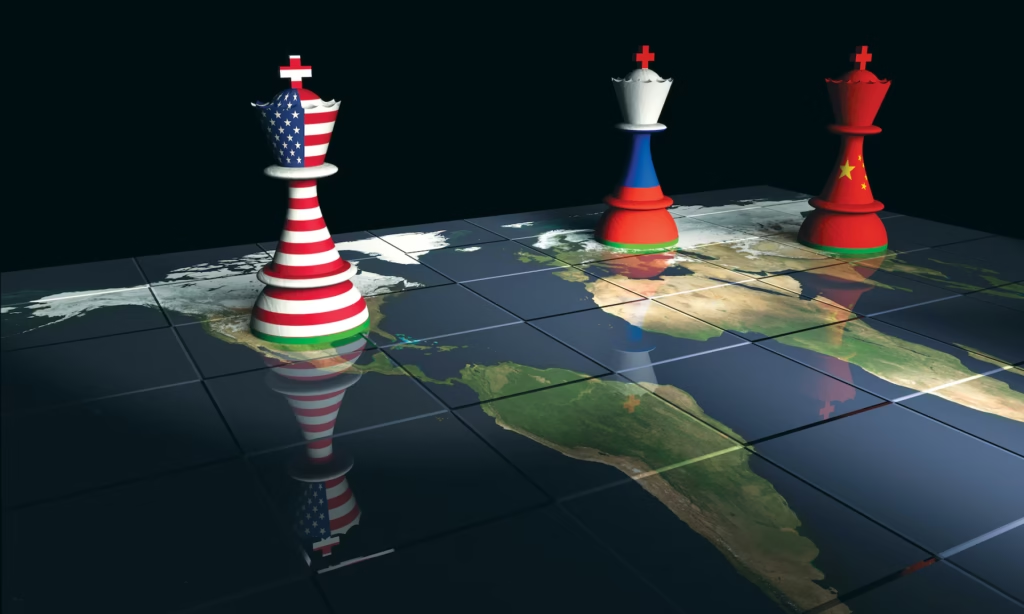
However, the global landscape has changed dramatically during the past decade. The rise of China as a strategic competitor to the United States, Russia’s military expansionism, growing instability in the Middle East, technological competition, and the fragmentation of international alliances have collectively accelerated the return of what many strategists now describe as “great power competition.”
Today, global politics is increasingly defined by rivalry between major powers seeking influence over trade routes, technology, energy resources, military dominance, and strategic regions. This competition is reshaping defence spending, military alliances, economic policy, and global security architecture in ways not seen since the Cold War.
Unlike the bipolar order of the 20th century, however, the emerging geopolitical environment is more fragmented, technologically interconnected, and economically complex. The result is a new era of strategic competition where military confrontation, cyber warfare, economic coercion, artificial intelligence, and information operations operate simultaneously across multiple domains.
The End of the Post-Cold War Order
The post-Cold War era was characterized by overwhelming American military, economic, and political dominance. The United States maintained unmatched global influence through NATO, international financial institutions, technological leadership, and military deployments across multiple regions.
Yet several developments gradually weakened this unipolar system.
China’s extraordinary economic rise transformed it into the world’s second-largest economy and a rapidly expanding military power. Russia, under Vladimir Putin, pursued a strategy aimed at restoring geopolitical influence lost after the Soviet collapse. Meanwhile, wars in Iraq and Afghanistan exposed the limits of Western military interventions and contributed to strategic fatigue within the United States and Europe.
At the same time, globalization created new vulnerabilities. Supply chains, energy markets, semiconductors, rare earth minerals, and digital infrastructure became strategic battlegrounds rather than neutral economic spaces. Competition increasingly expanded beyond military capabilities into technological dominance and economic resilience.
The Russian invasion of Ukraine in 2022 symbolized the definitive collapse of the post-Cold War security framework in Europe. It demonstrated that large-scale interstate war had returned to the center of global politics.
The United States and Strategic Containment
The United States remains the world’s most powerful military actor, but its strategic focus has shifted significantly toward containing emerging competitors, particularly China.
Washington increasingly views Beijing not simply as an economic competitor, but as a long-term strategic rival capable of challenging American influence globally. This perception has shaped U.S. defence strategy, technology policy, trade restrictions, and alliance-building efforts across the Indo-Pacific region.
American military planning now prioritizes deterrence in the Pacific, particularly regarding Taiwan and the South China Sea. The U.S. has strengthened partnerships with Japan, South Korea, Australia, and the Philippines while expanding regional security frameworks such as AUKUS and the Quad alliance.
At the same time, the United States faces the challenge of balancing commitments across multiple theatres simultaneously. Supporting Ukraine against Russia while preparing for potential escalation with China creates immense military and economic pressures.
This strategic overstretch is becoming one of Washington’s central geopolitical dilemmas.
China’s Rise as a Global Power
China’s rise represents the most significant geopolitical transformation of the 21st century. Unlike the Soviet Union during the Cold War, China combines economic integration with technological ambition and military modernization.
Beijing’s strategy extends far beyond traditional military expansion. Through initiatives such as the Belt and Road Initiative (BRI), China has expanded infrastructure investments, trade networks, and political influence across Asia, Africa, Latin America, and the Middle East.
Simultaneously, China is rapidly modernizing its armed forces. The People’s Liberation Army (PLA) is investing heavily in naval power, hypersonic missiles, cyber warfare, space capabilities, artificial intelligence, and drone systems. China’s military doctrine increasingly focuses on denying U.S. forces operational superiority in the Indo-Pacific.
Taiwan remains the most dangerous flashpoint in U.S.–China relations. Beijing considers reunification a strategic priority, while Washington maintains commitments to Taiwan’s defence. Any military confrontation over Taiwan would likely have catastrophic global economic and security consequences.
The Taiwan issue increasingly shapes global military planning, semiconductor supply chains, and alliance structures across Asia.
Russia and the Militarization of Geopolitics
Russia’s strategy under Vladimir Putin reflects an effort to reassert influence over former Soviet territories and challenge Western dominance.
The invasions of Georgia in 2008, Crimea in 2014, and Ukraine in 2022 were part of a broader strategy aimed at preventing NATO expansion and restoring Russian geopolitical influence.
Although the Ukraine war exposed weaknesses within the Russian military, it also demonstrated Moscow’s willingness to sustain prolonged conflict despite severe sanctions and international isolation. Russia adapted by deepening ties with China, Iran, and North Korea while expanding domestic military production.
The war also transformed European security policy. NATO expanded further with the inclusion of Finland and Sweden, while European states dramatically increased defence spending after decades of military reductions.
Russia’s confrontation with the West has effectively revived large-scale military deterrence in Europe for the first time since the Cold War.
Technology as the New Battlefield
One of the defining characteristics of modern great power competition is the central role of technology.
Competition now revolves around artificial intelligence, semiconductors, quantum computing, cybersecurity, satellite systems, and telecommunications infrastructure. Technological dominance increasingly determines military capability, economic power, and geopolitical leverage.
Semiconductors have become particularly critical. Advanced chips power everything from military systems and artificial intelligence to civilian industries and communications infrastructure. Taiwan’s dominance in semiconductor manufacturing has therefore become strategically vital to both the United States and China.
Cyber warfare has also emerged as a major domain of confrontation. States increasingly conduct cyber espionage, infrastructure attacks, influence campaigns, and digital sabotage operations against rivals without crossing into conventional warfare.
Future geopolitical competition may be determined as much by technological innovation as by traditional military strength.
The Middle East and Strategic Realignment
The Middle East remains one of the most contested regions within global power competition. The region’s energy resources, strategic waterways, and political instability continue to attract international involvement from major powers.
China has expanded economic influence through energy partnerships and infrastructure investments. Russia increased its regional role through military intervention in Syria and partnerships with Iran. Meanwhile, the United States continues to maintain extensive military deployments despite efforts to reduce direct involvement.
Regional actors themselves are increasingly pursuing independent foreign policies. Saudi Arabia, the UAE, Turkey, Iran, and Qatar are diversifying strategic partnerships rather than relying exclusively on traditional Western alliances.
This multipolar regional environment reflects broader global fragmentation.
Economic Warfare and Sanctions
Economic coercion has become one of the primary tools of modern great power competition.
Sanctions, export controls, financial restrictions, and trade barriers are now used extensively to pressure rival states. The Western sanctions campaign against Russia following the invasion of Ukraine represents one of the largest economic warfare operations in modern history.
At the same time, China and Russia have accelerated efforts to reduce dependence on Western financial systems and the U.S. dollar. Discussions surrounding alternative payment systems, local currency trade, and economic blocs increasingly reflect concerns about financial vulnerability.
Economic interdependence, once viewed as a stabilizing force, is now increasingly treated as a potential strategic liability.
The Militarization of Space
Space has emerged as another critical arena of great power rivalry.
Modern militaries rely heavily on satellites for communications, navigation, intelligence gathering, missile guidance, and surveillance. Consequently, anti-satellite weapons, space-based sensors, and orbital military capabilities are becoming major strategic priorities.
The United States, China, and Russia are all investing heavily in military space programs. Future conflicts may involve direct attacks on satellite infrastructure, potentially disrupting communications, global positioning systems, financial networks, and military operations worldwide.
The militarization of space represents one of the least regulated but most strategically important dimensions of modern competition.
A Fragmented Multipolar World
Unlike the Cold War, the emerging international system is not strictly bipolar. Instead, it is increasingly multipolar and fragmented.
Middle powers such as India, Turkey, Brazil, Saudi Arabia, and Indonesia are pursuing more autonomous foreign policies, seeking strategic flexibility rather than rigid alignment with either Washington or Beijing.
This creates a more unpredictable international environment where alliances are fluid, regional conflicts intersect with global competition, and economic interests often outweigh ideological divisions.
The result is a world characterized by overlapping rivalries rather than clearly defined blocs.
Conclusion
The return of great power competition marks a fundamental transformation in global politics. Military rivalry, technological competition, economic coercion, and geopolitical fragmentation are reshaping international security on a scale not seen since the Cold War.
However, today’s competition is more interconnected and multidimensional than previous eras. Economic globalization, cyber warfare, artificial intelligence, and transnational supply chains create both vulnerabilities and interdependence among rival powers.
The future international order will likely be shaped not by a single dominant power, but by a prolonged period of strategic competition involving multiple actors across military, technological, economic, and informational domains.
How states manage this competition will determine the trajectory of global stability, economic security, and international conflict throughout the 21st century.