
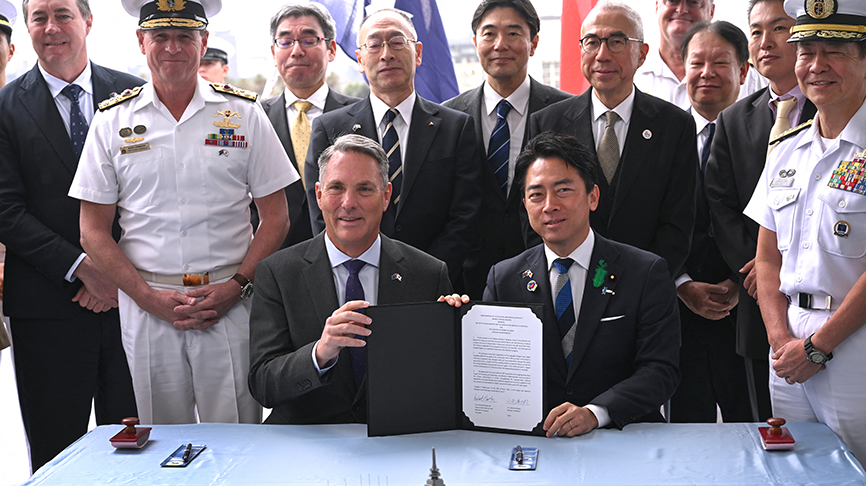
The recent depth of military cooperation between Australia and Japan marks a new chapter in the importance of emerging defence frameworks in the Indo-Pacific, without formal alliances.
Japan and Australia are building a partnership which could be a model for a new format of defence collaboration outside a formal treaty alliance.
While treaty alliances have been the backbone of transatlantic partnerships, the Indo-Pacific has been the theatre for strategic alliances outside of mutual defence treaties. Some of the biggest advantages of the Indo-Pacific as a strategic theatre have been to test emerging frameworks rooted in shared interests and converging threats without the infrastructure of a mutual defence treaty. Beyond groupings such as the Quad, which includes Australia, India, Japan and the United States, and the AUKUS security partnership, which includes Australia, the United Kingdom and the US, an evolving yet powerful framework is the growing defence partnership between Australia and Japan.
Mutual support
Tokyo and Canberra have a long-standing history of engagements with shared concerns, priorities and interests within the Indo-Pacific security theatre – this year marks the 50th anniversary of the Japan–Australia Basic Treaty of Friendship and Cooperation. While both states benefit from a strong alliance with the US, this did not immediately translate into a strong bilateral defence relationship between Japan and Australia. However, with Japan and Australia having operated with the US through bilateral and multilateral engagements as well as sharing views and perceptions about the region and its emerging threats, the bilateral relationship is well suited to being sustainable and strategically important for both. Amid US reprioritisations, Australia and Japan seem to be cementing that relationship.
One important recent development was the signing of the bilateral Reciprocal Access Agreement (RAA) in 2022 and implemented in 2023. At the time, this was Japan’s only visiting-forces agreement, other than the one with the US. The RAA enhances Tokyo and Canberra’s operational relationship in the Indo-Pacific, given that the two countries are geographically situated across some of the most important straits and choke points in the western and southern Pacific. The RAA enables streamlined deployments, exercises and joint activities, and reflects a level of political trust previously reserved only for Tokyo’s closest ally, the US. That trust is being operationalised at scale. In recent consultations, Japanese and Australian defence ministers underlined the impact of the RAA, noting a ‘high tempo… with over 40 activities’ conducted together within a year, spanning air, maritime, land and cyber domains. These operational developments are crucial for augmenting both Japanese and Australian logistics capabilities, experience and inter-operability in the region, especially given that Tokyo and Canberra sit north and south of the Taiwan Strait.
The logistics capability is being complemented by alignment in industrial cooperation. Japan’s advanced Mogami-class frigate is replacing Australia’s ‘Anzac-class frigates and will be equipped for undersea warfare and air defence’. Canberra’s decision to select the upgraded Mogami-class as its next general purpose frigate underscores growing industrial and operational compatibility. In April 2026, the Japanese government announced major changes to Japan’s defence export rules. This fundamental shift in Tokyo’s arms sales policy only adds further opportunities for the defence relationship to grow and adapt to a volatile Indo-Pacific security environment.
Under the technological frontier, collaborations potentially under AUKUS Pillar II (on advanced capabilities) capture the direction and strength of the relationship. Australia and Japan are pursuing projects such as maritime autonomous systems, an important marker of both interest in and the depth of the defence partnership for both sides.
In addition, while the RAA was signed in 2022, the relationship witnessed significant milestones in 2025. Japanese and Australian defence ministers Koizumi Shinjiro and Richard Marles, in December 2025, announced a new Framework for Strategic Defence Coordination (FSDC) to institute strategic alignment applicable ‘at all levels and in all situations’. The relationship has all the foundational structures in place to realise the potential of the FSDC – ‘increased information sharing, further alignment of activities, and deepening discussions on current and future deterrence activities – such as Flexible Deterrent Options’. This new framework captures the trajectory of the Australia–Japan bilateral relationship, where defence has taken a stronger lead, shaped by both competition with China and calls for greater burden-sharing from a shared ally.
US involvement
It is important to note, however, that this developing relationship between two partners of the US does not mean keeping Washington out of the framework. It’s about leveraging shared operational standards and habits of cooperation traditionally reserved for treaty alliances. The establishment of the Japan–Australia–U.S. Navy Logistics Working Group in 2025 points toward shared sustainment, mobility and operational planning between the three states.
A new Indo-Pacific model?
In short, Japan and Australia might be offering a credible and sustainable model for how Indo-Pacific states can build deep, operationally meaningful security ties in the absence of a formal treaty alliance. More importantly, it is perhaps an increasingly necessary model given growing competition and military aggression, as well as Washington’s repeated calls for its allies to do more themselves.
Centred on offering deterrence options, Tokyo and Canberra are stepping forward to forge a relationship that mirrors the reality of a volatile strategic environment. The ability to extend and share sustainable, foundational defence agreements, and to plan future scenarios utilising these agreements, is an important and necessary step in the Indo-Pacific, with or without a treaty alliance. As the Indo-Pacific region confronts a new geopolitical and strategic reality, it will have no choice but to develop new defence partnership frameworks regardless of alliances. Alliances will just be one option for defence cooperation within the region. The uncomfortable truth is, regardless of Washington’s choices, Tokyo and Canberra will have to absorb and adapt to the military environment in the western Pacific, changes to which directly impact each of their national security interests.