
The Global Institute for Strategic Studies (GISS)
September 2026
Executive Summary
A profound transformation in military power is becoming visible through the wars and security crises of 2026. The expanding use of long-range drones, increasingly sophisticated unmanned systems, electronic warfare and artificial intelligence is challenging assumptions that shaped air power for decades. The ability to conduct sustained strikes deep behind an adversary’s front lines was once concentrated among states possessing expensive combat aircraft, cruise missiles, large military bases and highly trained personnel. Unmanned systems are beginning to erode that monopoly. They allow militaries to generate large numbers of comparatively inexpensive strike platforms, distribute them across wide areas and replace losses far more easily than traditional aircraft. The result is not the disappearance of conventional air power, but the emergence of a second layer of air warfare based on scale, expendability and continuous technological adaptation.
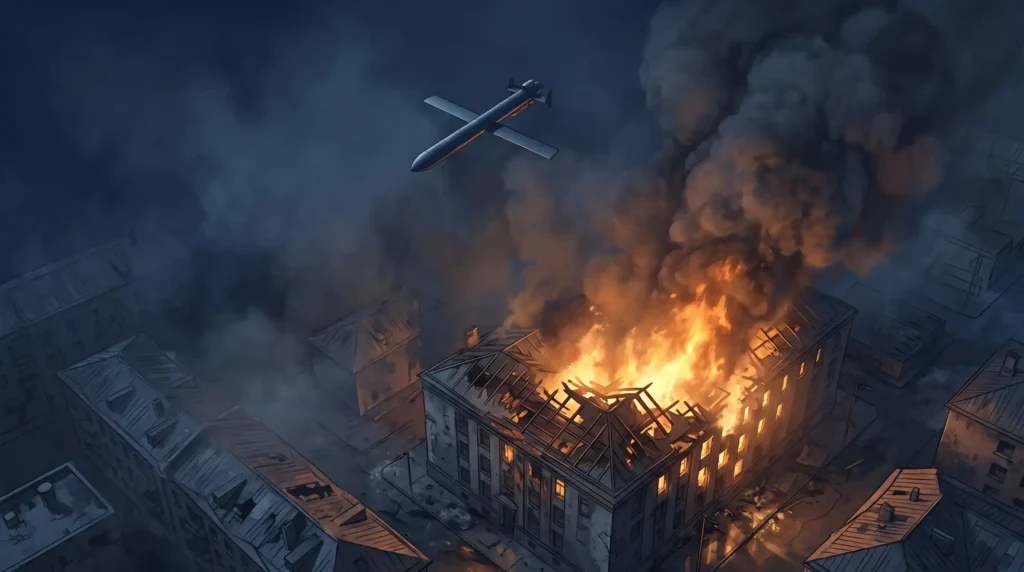
The Russia-Ukraine war has become the most visible laboratory for this transformation. Russia has increasingly combined different categories of drones and missiles in large-scale attacks designed not only to destroy specific targets but also to stretch Ukrainian air-defence resources. Ukraine, meanwhile, has demonstrated how long-range drones can threaten refineries, military facilities, logistics networks and other infrastructure deep inside Russian territory. The strategic importance of these campaigns extends beyond the physical damage caused by individual strikes. Each side is attempting to impose an economic and operational burden on the other by forcing expensive defensive responses, dispersing air-defence assets and making previously secure infrastructure vulnerable.
The wider implication is that the economics of air power are changing. A relatively inexpensive drone does not necessarily need to penetrate an air-defence network to produce strategic value. If it forces the defender to activate radars, reposition units, launch costly interceptors or protect infrastructure hundreds of kilometres from the battlefield, it has already imposed costs. When attacks involve hundreds of systems, this pressure can become cumulative. Saturation itself becomes a weapon because the defender must distinguish genuine strike systems from decoys, allocate limited interceptors and protect a much larger number of potential targets than the attacker needs to strike.
For The Global Institute for Strategic Studies (GISS), this transformation points toward a new equation of military power. Future military superiority will not depend exclusively on possessing the most technologically sophisticated individual platform. It will increasingly depend on whether states can combine advanced systems with large quantities of inexpensive weapons, connect them through resilient digital networks and adapt them faster than opponents can develop countermeasures. The emerging military competition can therefore be understood through a simple strategic formula: quality multiplied by mass, connected by software and sustained by industrial capacity.
The Return of Mass Warfare in a Technological Form
For several decades after the Cold War, Western military doctrine increasingly emphasised technological superiority over numerical mass. Precision-guided weapons, stealth aircraft, sophisticated intelligence systems and advanced command networks appeared to offer a model in which smaller forces could achieve overwhelming effects through information dominance and accuracy. This approach was reinforced by conflicts in which Western militaries generally possessed substantial technological and air superiority. Expensive platforms were acceptable because they were expected to survive, while precision was supposed to reduce the enormous ammunition requirements historically associated with industrial warfare.
The experience of Ukraine has challenged the assumption that technology can permanently substitute for mass. Sophisticated systems remain indispensable, but prolonged high-intensity warfare consumes equipment, ammunition and personnel at rates that peacetime procurement structures were never designed to sustain. Drones have become particularly important because they provide a way to regenerate military mass without reproducing the enormous industrial structures required to manufacture conventional aircraft or missiles in equivalent quantities. A state may not be capable of producing hundreds of advanced combat aircraft each year, but it may be able to manufacture tens of thousands of unmanned systems using commercially available components and comparatively flexible production lines.
This does not mean that cheap drones are replacing advanced weapons. Their importance comes from interaction with them. A low-cost reconnaissance drone can locate a target for expensive artillery ammunition. A group of decoy drones can force an air-defence network to reveal its position before a more sophisticated missile arrives. Long-range attack drones can consume defensive ammunition while cruise or ballistic missiles exploit the resulting pressure. Mass therefore becomes strategically valuable when combined with high-end capabilities rather than when treated as an alternative to them.
The twenty-first century is consequently witnessing the return of mass warfare in a new technological form. The industrial wars of the twentieth century generated mass through millions of soldiers, thousands of tanks and enormous artillery inventories. The emerging model may increasingly generate mass through networks of autonomous and semi-autonomous machines. The strategic principle remains familiar—quantity creates operational possibilities—but the mechanisms through which quantity is produced are changing dramatically.
The Economics of Air Defence Are Becoming a Strategic Vulnerability
One of the most important consequences of drone warfare concerns the cost of interception. Traditional air-defence systems were developed primarily to defeat aircraft, ballistic missiles and sophisticated cruise missiles. These are valuable targets, which can justify the use of expensive interceptors. The equation becomes more difficult when the incoming target is a relatively inexpensive unmanned aircraft. A defender may successfully destroy every attacking drone and still lose part of the economic competition if the cost of interception is consistently far higher than the cost of attack.
This asymmetry becomes particularly serious during prolonged campaigns. Air-defence missiles require sophisticated manufacturing, specialised components and lengthy production processes. Inventories cannot always be replenished as rapidly as they are consumed. The attacker can exploit this constraint by sending large numbers of inexpensive systems alongside smaller quantities of sophisticated weapons. Defenders then face an uncomfortable choice: use expensive interceptors against cheap targets, allow some drones to pass through the defensive network, or rely on cheaper defensive technologies that may not provide the same probability of interception.
The strategic objective of a saturation campaign is therefore not necessarily to penetrate every layer of defence. It can instead seek to exhaust the defensive system economically and operationally. Radars must remain active. Personnel must remain on alert. Aircraft may need to be scrambled. Mobile air-defence units must reposition. Ammunition must be consumed and replaced. Critical infrastructure must be protected across enormous geographic areas. Even unsuccessful attacks can therefore generate persistent costs.
This creates a new form of strategic attrition. Instead of attempting to destroy an opponent’s air force directly, an attacker can seek to force the opponent to spend resources faster than those resources can be regenerated. The battle becomes partly a competition between production systems: the rate at which the attacker can manufacture drones against the rate at which the defender can manufacture interceptors and other countermeasures.
The Factory Is Becoming Part of the Weapon System
Industrial capacity has always influenced military outcomes, but drone warfare is shortening the distance between factory and battlefield. Modern unmanned systems can often be redesigned rapidly in response to operational experience. Components can be replaced, navigation systems modified, electronic protection improved and flight profiles adjusted without redesigning an entire weapons platform. Production lines therefore become part of the military adaptation process rather than simply facilities that reproduce a fixed design.
This creates an important distinction between platform warfare and production warfare. Traditional procurement systems often concentrate enormous technological capability inside individual platforms designed to remain operational for decades. Production warfare instead emphasises how quickly capabilities can be manufactured, modified, replaced and expanded. The strategic value of a system is determined not only by how well it performs individually but also by whether it can be produced at sufficient scale and modified quickly enough to survive the adversary’s countermeasures.
For NATO and European militaries, this presents a significant challenge. Increased defence budgets do not automatically create military capability. Governments can announce billions in additional spending, but those resources matter strategically only when they are converted into production capacity, ammunition inventories, trained personnel and deployable systems. A military-industrial system designed primarily to manufacture small quantities of extremely sophisticated equipment may struggle when warfare requires thousands or tens of thousands of comparatively inexpensive systems.
The future defence industry may therefore need two production models operating simultaneously. One will continue manufacturing high-end aircraft, submarines, air-defence systems, satellites and precision missiles. The other will need to manufacture inexpensive drones, sensors, electronic-warfare systems and interceptors in quantities traditionally associated with commercial manufacturing. Military superiority will depend increasingly on the ability to connect these two industrial ecosystems.
Jet-Powered Drones Are Blurring the Boundary with Cruise Missiles
The emergence of faster jet-powered drones illustrates how quickly the technological categories of air warfare are becoming blurred. Traditional propeller-driven attack drones possess important advantages because they can travel considerable distances at relatively low cost. Their principal weakness is speed. Slow flight provides defenders with more time to detect, classify and intercept them, particularly when layered radar networks and mobile interception units are available.
Jet propulsion changes the equation by compressing reaction time. Faster drones reduce the period available for air-defence operators to identify targets, calculate trajectories and allocate weapons. Mobile interception teams have fewer opportunities to reposition, while defensive aircraft may face greater difficulty engaging targets across wide geographic areas. The cost of jet propulsion remains higher than that of simpler propeller systems, but technological development and mass production could gradually narrow the difference.
The strategic significance lies in the possibility of creating weapons that occupy the space between inexpensive attack drones and sophisticated cruise missiles. If militaries can produce faster unmanned strike systems at substantially lower cost than conventional cruise missiles, saturation attacks could become significantly more difficult to defeat. Defenders would confront larger numbers of targets travelling at speeds that reduce the effectiveness of cheaper interception methods.
Future attacks could consequently combine slow drones, jet-powered drones, decoys, cruise missiles and ballistic missiles within the same operation. Each category would impose a different detection and interception problem. The defender would have to decide rapidly which targets justify expensive interceptors and which can be engaged by cheaper systems. The attacker would attempt to exploit precisely that uncertainty.
The Future Attack Will Be an Integrated System
The popular concept of the “drone swarm” captures only part of the emerging transformation. The most sophisticated future attacks may not consist of thousands of identical drones moving toward the same target. They are more likely to involve heterogeneous networks in which different systems perform specialised functions within a coordinated operation.
Some drones could conduct reconnaissance and transmit targeting information. Others could generate electronic interference or attempt to disrupt communications. Decoys could imitate the radar signatures or flight profiles of more dangerous weapons, forcing defenders to reveal positions or waste interceptors. Dedicated systems could search for air-defence radars, while long-range strike drones attack infrastructure identified by reconnaissance platforms. Cruise and ballistic missiles could arrive later, exploiting gaps created during the initial saturation phase.
Cyber operations could simultaneously target communications networks or electricity systems. Space-based assets could provide navigation and intelligence. Artificial intelligence could process sensor information and recommend targeting priorities. The result would be much more than a collection of drones. It would constitute a distributed strike architecture in which different technologies reinforce one another.
Defending against such attacks requires an equally integrated architecture. Radar, electronic warfare, interceptor drones, conventional air-defence missiles, fighter aircraft, passive sensors and cyber defence cannot operate as isolated capabilities. They must exchange information quickly enough to create a coherent picture of the attack and allocate the cheapest effective defensive system to each threat.
Air Defence Must Become Layered by Cost
The economics of saturation warfare make a layered defensive architecture essential. High-end interceptors will remain necessary because ballistic missiles, sophisticated cruise missiles and advanced aircraft cannot reliably be defeated by inexpensive countermeasures alone. But using these weapons against every incoming drone would impose unsustainable costs during prolonged conflict.
Future air defence therefore needs a cost hierarchy. Electronic warfare can disrupt the navigation or communications of some drones without firing a physical weapon. Mobile gun systems can engage relatively slow targets. Cheap interceptor drones can destroy attacking drones at costs closer to those of the incoming systems. Directed-energy weapons may eventually provide another layer if technical challenges involving range, weather, power generation and reliability can be overcome. High-end missile interceptors can then be reserved for the most dangerous threats.
The objective is not merely technological efficiency. It is strategic sustainability. A defensive architecture must be capable of operating for months or years rather than performing impressively during the opening days of conflict before ammunition inventories become critically depleted. The cheapest effective defensive mechanism should therefore engage each category of threat whenever operational conditions permit.
This principle could transform military procurement. Instead of evaluating air-defence systems primarily according to maximum technical performance, planners will increasingly need to consider cost per engagement, ammunition regeneration rates and industrial scalability. A technically superior system that cannot be produced in sufficient quantities may provide less wartime value than a somewhat less capable system available at enormous scale.
Artificial Intelligence Will Accelerate the Transformation
Artificial intelligence is likely to become one of the strongest accelerators of drone warfare because it can reduce dependence on continuous human control. Many existing drones remain vulnerable because they depend on satellite navigation, radio communications or direct operator control. Electronic warfare can interfere with these links, potentially degrading or disabling systems.
Greater autonomy can reduce these vulnerabilities. AI-enabled navigation can allow drones to compare terrain or visual information with stored maps when satellite positioning is unavailable. Automated object recognition can help reconnaissance systems identify potential targets from enormous quantities of imagery. Multiple drones can coordinate routes or distribute surveillance tasks without requiring an operator to manually control every movement.
The most important consequence may be scalability. A military in which one operator must continuously control one drone faces a human-resource constraint. A system in which one operator supervises multiple semi-autonomous drones can generate far greater mass. Artificial intelligence therefore changes not only the technical performance of individual systems but also the manpower economics of drone warfare.
This development will raise serious legal, ethical and command questions, particularly concerning lethal autonomous decision-making. But even if militaries retain humans in decisions involving the use of force, substantial portions of navigation, reconnaissance, target classification and coordination can become increasingly automated. The battlefield will consequently become more machine-readable and decision cycles will accelerate.
The Sensor War May Become More Important Than the Drone War
Drones cannot generate strategic effects without information. A strike system needs to know where it is, where its target is located and whether that target remains relevant when the weapon arrives. This means that the drone revolution is simultaneously creating a revolution in sensing and targeting.
Satellites, reconnaissance aircraft, commercial imagery, radar networks, acoustic sensors, electronic intelligence and battlefield surveillance can all contribute to a continuously updated operational picture. Artificial intelligence can process this information much faster than traditional human analytical structures, potentially reducing the time between detecting a target and attacking it.
This creates what may become one of the most important measures of future military effectiveness: the speed of the sensor-to-shooter chain. A military capable of detecting a target and engaging it within minutes possesses a fundamentally different capability from one requiring hours of communication and command approval.
Future competition will therefore concern decision speed as much as weapons range. Militaries will attempt to accelerate their own targeting cycles while disrupting those of their opponents through electronic warfare, cyber operations, deception and attacks against communications networks. Information infrastructure becomes part of the battlefield because destroying the network connecting sensors to weapons can sometimes be more valuable than destroying the weapons themselves.
Strategic Depth Is Becoming Shallower
Long-range drones are also changing military geography. Historically, distance from the frontline provided substantial protection. Refineries, air bases, factories and logistics centres located hundreds of kilometres behind combat zones were difficult to attack without sophisticated aircraft or long-range missiles. The proliferation of inexpensive long-range unmanned systems is reducing that protection.
Ukraine’s ability to conduct drone operations deep inside Russian territory illustrates the transformation. The strategic significance is not confined to the physical damage caused by individual strikes. Russia must consider the defence of infrastructure across an enormous geographic area. Air-defence systems that might otherwise protect military operations near the battlefield may need to defend refineries, industrial facilities, airports and other targets far behind the front.
Distance has not become irrelevant. Longer-range systems remain more difficult and expensive to build, while navigation, communications and payload requirements become more demanding. But the amount of distance required to create meaningful strategic protection is increasing.
This has implications far beyond Ukraine. States that previously assumed their industrial heartlands were protected by geography may need to reconsider air defence, infrastructure hardening and military dispersion. Strategic depth is no longer simply measured in kilometres. It increasingly depends on the opponent’s ability to manufacture inexpensive long-range strike systems.
Critical Infrastructure Is Becoming Part of the Battlespace
Drone warfare is expanding the target set from military formations toward the systems that allow modern societies and economies to function. Electricity substations, fuel depots, telecommunications facilities, rail junctions, ports, data centres and industrial plants can all become strategically valuable targets because disrupting them affects military and civilian activity simultaneously.
The attacker does not need to destroy an entire national network. Repeated attacks against carefully selected nodes can impose repair costs, interrupt production and force governments to distribute limited defensive resources across thousands of potential targets. This creates a fundamental defensive asymmetry: the attacker chooses where to concentrate, while the defender must consider protecting everything.
Modern societies therefore face a structural problem. They contain vastly more valuable infrastructure than governments possess air-defence systems. Even the wealthiest states cannot deploy sophisticated missile batteries beside every power station, bridge, communications centre, military factory and transport hub.
The response cannot rely exclusively on interception. Infrastructure itself must become more resilient. Electricity networks need redundancy. Military aircraft need dispersal options. Fuel supplies require distributed storage. Data centres need backup systems. Factories producing strategically important equipment need alternative facilities and rapid repair capabilities. The ability to absorb attacks becomes as important as the ability to prevent them.
Resilience Is Becoming Part of Deterrence
This transformation broadens the concept of deterrence. Traditional deterrence focuses heavily on retaliation: convincing an adversary that aggression will trigger unacceptable consequences. Drone warfare increases the importance of deterrence by denial—convincing the adversary that attacks will fail to generate sufficient strategic benefits.
If an attacker believes that several hundred inexpensive drones can paralyse a country’s electricity system or close major transportation networks, the incentive to use them increases. If infrastructure is redundant, repairs are rapid and inexpensive defensive systems can neutralise much of the attack, the expected benefit declines.
Civilian resilience therefore becomes part of military power. Backup generators, spare transformers, redundant fibre-optic networks, dispersed warehouses and rapid-repair teams may appear far removed from conventional military capability, yet they directly influence whether strategic attacks can achieve their objectives.
This is particularly important for NATO because military reinforcement depends heavily on civilian infrastructure. Ports, railways, telecommunications networks, electricity systems and commercial transportation would all play critical roles during a major European conflict. Protecting them therefore cannot remain solely a civilian economic responsibility.
The Global Consequences Extend Beyond Ukraine
The lessons emerging from Ukraine will not remain confined to Europe. In the Indo-Pacific, enormous distances and concentrated military infrastructure create conditions in which long-range unmanned systems could play an important role. Air bases, ports, fuel-storage facilities, radar sites and logistics hubs could face repeated saturation attacks intended to reduce operational tempo rather than destroy every target completely.
The Middle East provides another environment in which drones can alter strategic balances. States and non-state actors have already demonstrated the ability to threaten energy infrastructure, military bases and maritime traffic using comparatively inexpensive unmanned systems. The diffusion of these technologies lowers the barrier to long-range precision attack and gives smaller actors capabilities that previously required conventional air forces or expensive missile programmes.
This represents a significant redistribution of military power. A relatively small state may never be able to acquire and sustain a large fleet of sophisticated combat aircraft, but it may be capable of developing thousands of long-range drones. Non-state actors may similarly gain limited strategic-strike capabilities using commercially derived technologies.
The barrier separating tactical actors from strategic strike is therefore becoming lower.
Large Military Platforms Will Need New Protection
The drone revolution will not make aircraft carriers, combat aircraft or major military bases obsolete. Large platforms provide capabilities that inexpensive unmanned systems cannot easily reproduce. But their defence is likely to become more complicated and expensive.
A high-value platform does not necessarily need to be destroyed to lose operational effectiveness. Repeated attacks can force it to operate farther from contested areas, consume defensive ammunition or devote increasing resources to protection. The same logic applies to military air bases, where aircraft, fuel storage, maintenance facilities and runways concentrate enormous military value in relatively predictable locations.
This pressure may encourage a renewed emphasis on dispersion. Militaries may rely on larger numbers of smaller operating locations, distributed fuel storage, hardened shelters, mobile logistics, decoys and rapid runway repair. The technological revolution could therefore restore several traditional military principles that had become less prominent during periods of uncontested Western air superiority.
Concentration produces efficiency, but dispersion produces survivability.
Future military planning will need to balance both.
The Industrial Competition Will Become Global
The states that dominate drone production ecosystems may acquire strategic advantages comparable to those enjoyed historically by countries that dominated aircraft, shipbuilding or missile production. The relevant capability is not simply designing an advanced drone. It is controlling the industrial ecosystem required to manufacture systems continuously and cheaply.
That ecosystem includes motors, sensors, batteries, navigation equipment, semiconductors, optics, communications systems, engines and increasingly artificial-intelligence software. Many of these technologies are dual-use, meaning civilian manufacturing capacity can become relevant to military power during crisis.
This blurs the distinction between defence industry and commercial industry. A country with an enormous electronics manufacturing sector may possess latent military production capabilities that conventional measurements of defence spending underestimate. Conversely, a country spending heavily on defence but dependent on foreign electronics, motors or semiconductors may discover that its production capacity is more fragile than its budget suggests.
Supply-chain security therefore becomes military strategy.
Europe Faces a Production Challenge, Not Merely a Spending Challenge
European states are dramatically increasing defence expenditure, but the drone revolution demonstrates why spending alone is an incomplete measure of military readiness. Budgets must ultimately translate into factories, trained personnel, ammunition, software, repair capacity and deployable systems.
Europe’s defence-industrial structure was largely designed for a period in which governments ordered relatively small quantities of sophisticated platforms over long procurement cycles. High-intensity warfare creates different requirements. Systems must be manufactured quickly, replaced after losses and modified continuously in response to battlefield experience.
The challenge is therefore organisational as well as financial. European defence ministries need procurement mechanisms capable of buying technologies whose development cycles are measured in months rather than decades. Military units need closer relationships with engineers and manufacturers. Smaller technology companies need pathways into defence procurement without spending years navigating bureaucratic processes.
Europe may consequently need two parallel defence-industrial models: one optimised for complex strategic platforms with long service lives and another optimised for rapidly evolving expendable systems. Attempting to manufacture both categories through identical procurement structures risks producing systems that arrive too slowly or cost too much to deploy at scale.
The Next Arms Race Will Be About Adaptation
Traditional arms races are usually measured through inventories. Analysts count tanks, aircraft, ships, missiles and nuclear warheads. The emerging military competition requires an additional metric: adaptation speed.
Drone technology evolves extraordinarily quickly because many components originate in commercial markets and software can be modified without rebuilding entire platforms. An electronic-warfare technique that works effectively today may become less effective after the opponent changes frequencies or navigation methods. A successful interceptor can encourage attackers to alter altitude or speed. A new sensor can generate new camouflage techniques.
Technological advantage therefore becomes temporary.
This creates what could be described as adaptation superiority. The military possessing the most effective weapon at the beginning of a conflict may eventually be overtaken by an opponent capable of learning faster. Procurement systems built around decade-long acquisition cycles are poorly suited to an environment in which operational advantages can disappear within months.
Future military organisations will therefore need permanent feedback loops connecting frontline units, intelligence organisations, engineers, software developers and manufacturers. Battlefield experience must reach designers quickly, while modifications must return to operational units at industrial speed.
In this environment, software updates may become strategically comparable to ammunition deliveries.
Quantity and Quality Are No Longer Opposing Strategies
The most important conclusion from the drone revolution is not that inexpensive systems will replace sophisticated weapons. Military forces that draw that conclusion would risk sacrificing capabilities that remain essential. Advanced aircraft, submarines, satellites, long-range missiles and integrated air-defence systems will continue providing capabilities that cheap drones cannot reproduce.
The transformation concerns the relationship between quality and quantity.
A sophisticated satellite may detect a target. An advanced command network may process the information. Artificial intelligence may help identify its significance. A relatively inexpensive drone may then conduct the strike. Expensive systems provide information and coordination while cheap systems generate mass.
Military power increasingly emerges from the network connecting these capabilities rather than from any individual platform.
The future force therefore needs both sophisticated systems and expendable ones. It needs technologies that survive for decades and systems designed to be lost during a single mission. It needs large defence contractors capable of constructing enormously complex platforms and smaller companies capable of changing software or drone designs within weeks.
The strategic advantage belongs to the military capable of integrating all of them.
Conclusion: The Weapon Is Becoming the Network
The drone revolution should not be understood as simply another technological chapter in the history of warfare. It is changing the economics, geography and industrial foundations of military power simultaneously. Inexpensive long-range systems are reducing the protection traditionally provided by strategic depth. Saturation attacks are challenging the economic sustainability of sophisticated air defence. Artificial intelligence is increasing autonomy and potentially allowing smaller numbers of operators to control larger numbers of machines. Civilian manufacturing ecosystems are becoming increasingly relevant to military production, while critical infrastructure is becoming inseparable from the battlefield.
For The Global Institute for Strategic Studies (GISS), the central strategic implication is that military power is entering a hybrid industrial-technological era. The twentieth century rewarded states capable of mass-producing tanks, aircraft, ships and artillery ammunition. The post-Cold War period rewarded militaries capable of producing smaller numbers of extraordinarily sophisticated precision systems. The emerging era may require both models simultaneously.
Countries will need advanced combat aircraft and inexpensive drones, ballistic-missile defence and cheap interceptors, military satellites and commercial sensors, professional soldiers and increasingly autonomous machines. They will need hardened bases and distributed logistics, large defence companies and agile technology firms, military air defence and resilient civilian infrastructure. None of these capabilities alone will be sufficient because the effectiveness of each increasingly depends on the network connecting it to the others.
The decisive strategic resource may therefore not be any particular drone, missile or artificial-intelligence system. It will be the institutional and industrial architecture capable of detecting a new threat, learning from it, designing a response, manufacturing that response at scale and deploying it before the adversary changes again.
This is why the emerging arms race will be fought not only in laboratories and on battlefields but also inside factories, software companies, procurement agencies and supply chains. The countries that dominate future warfare may not necessarily be those possessing the largest inventories at the beginning of a conflict. They may be those capable of regenerating and transforming those inventories faster than their opponents.
The next revolution in warfare will therefore not be decided by the state possessing the single most advanced weapon. It will be decided by the state capable of turning technology into mass, mass into networks, networks into resilient combat power and battlefield experience into continuous industrial adaptation.