
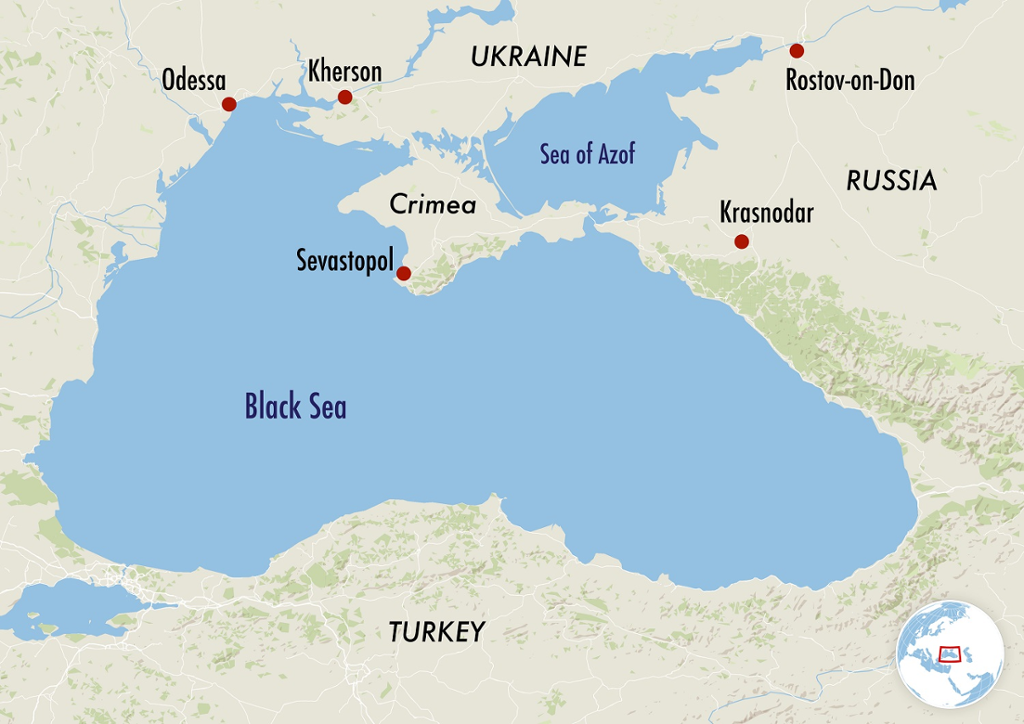
The Black Sea has re-emerged as one of the most consequential strategic theatres in the Euro-Atlantic security architecture. Once viewed primarily as a regional maritime space linking Eastern Europe, the Caucasus, and the Middle East, it has evolved into a central arena where military competition, energy security, economic resilience, and geopolitical influence intersect. Russia’s full-scale invasion of Ukraine fundamentally altered the strategic balance of the region, transforming the Black Sea from a peripheral maritime environment into one of Europe’s principal security frontiers. Today, developments within the basin directly influence NATO’s eastern deterrence posture, European energy diversification, global food security, maritime commerce, and the stability of the Alliance’s southeastern flank.
The strategic significance of the Black Sea extends well beyond conventional naval competition. Modern conflict increasingly unfolds through interconnected domains where military operations are reinforced by cyberattacks, infrastructure sabotage, economic coercion, information warfare, and the disruption of commercial shipping. The region now hosts an unprecedented concentration of strategic assets, including critical energy infrastructure, submarine communication cables, offshore energy projects, major commercial ports, and vital maritime trade routes linking Europe with the Caucasus, Central Asia, and the Eastern Mediterranean. The security of these assets has become inseparable from the broader resilience of the European economy and NATO’s collective defence posture.
This paper argues that the Black Sea should no longer be understood solely as NATO’s southeastern flank but as Europe’s emerging strategic maritime frontier. Protecting this frontier requires a comprehensive strategy that integrates naval deterrence, infrastructure protection, intelligence cooperation, defence industrial capacity, and regional partnerships with Black Sea states. The future credibility of European security will depend increasingly on the Alliance’s ability to secure this maritime space against both conventional and hybrid threats while preserving freedom of navigation and strengthening regional resilience.
Throughout much of the post-Cold War period, European strategic planning focused overwhelmingly on the Baltic region, the North Atlantic, and the Mediterranean. Although the Black Sea remained geographically important, it was often regarded as a secondary theatre whose security dynamics could be managed through existing regional frameworks and NATO’s broader deterrence posture. This perception has changed fundamentally. The combination of Russia’s military expansion, the prolonged war in Ukraine, increasing hybrid activity, and the growing strategic importance of energy and maritime infrastructure has transformed the Black Sea into one of the defining geopolitical fault lines of the twenty-first century.
The region occupies a unique position within the international system. It serves simultaneously as a maritime gateway connecting Europe to the South Caucasus and Central Asia, a corridor for energy transportation, a critical route for agricultural exports, and a strategic operating environment for NATO and Russia. Every major development affecting the Black Sea produces consequences extending well beyond its immediate geography. Disruptions to maritime trade influence global commodity markets; instability threatens European energy diversification; military escalation reshapes NATO’s force posture; and attacks against critical infrastructure undermine broader European resilience. Few maritime regions combine such diverse strategic functions within a relatively confined geographic space.
Recent years have demonstrated that control of the maritime domain is no longer measured exclusively by the size of naval fleets. Modern maritime security increasingly depends upon the protection of commercial shipping, offshore energy facilities, submarine communication cables, digital infrastructure, ports, logistics hubs, and surveillance networks. Consequently, the Black Sea has become an environment where military, economic, technological, and political competition overlap continuously. Adversaries no longer need to establish permanent naval dominance to achieve strategic influence. Instead, limited military actions, infrastructure sabotage, cyber operations, electronic warfare, or persistent uncertainty can generate disproportionate economic and political effects across Europe.
For NATO, these developments present both operational and strategic challenges. The accession of Finland and Sweden has strengthened the Alliance’s northern flank, yet attention is increasingly shifting towards the southeast, where Romania, Bulgaria, and Türkiye occupy pivotal positions within the Black Sea security architecture. These Allies collectively form NATO’s primary maritime presence in the region while simultaneously protecting critical transport corridors, energy infrastructure, and logistical networks essential for reinforcing the eastern flank. Their security is therefore inseparable from the credibility of NATO’s collective deterrence strategy.
The Black Sea also illustrates the changing character of strategic competition. Rather than representing a discrete military theatre, it has become an interconnected operational environment linking Europe’s eastern border, the Caucasus, the Eastern Mediterranean, and the broader Middle East. Military developments in one part of this system rapidly influence political and economic conditions elsewhere. The protection of commercial shipping affects global food security; offshore energy infrastructure shapes European energy resilience; and maritime surveillance contributes directly to NATO’s ability to monitor Russian military activity across multiple domains. As a result, the Black Sea should be understood not as an isolated regional issue but as an essential component of Europe’s wider strategic ecosystem.
This paper argues that the coming decade will be defined by Europe’s ability to develop a coherent Black Sea strategy that extends beyond crisis management and embraces long-term regional resilience. Such a strategy must integrate military deterrence, maritime domain awareness, infrastructure protection, defence industrial cooperation, energy security, and deeper partnerships with regional states. Only through this multidimensional approach can NATO and its European members preserve stability, deter aggression, and ensure that the Black Sea remains a secure maritime frontier rather than a persistent source of strategic vulnerability.
The Black Sea as NATO’s New Strategic Centre of Gravity
The strategic geography of Europe is undergoing a profound transformation. For much of the past two decades, NATO’s eastern security architecture concentrated primarily on the Baltic region, where concerns regarding Russian military activity, territorial defence, and forward deployment shaped the Alliance’s operational planning. While the Baltic Sea remains indispensable to European security, the Black Sea has emerged as an equally critical theatre whose strategic importance extends beyond regional defence. Unlike the Baltic, the Black Sea connects Europe directly with the Caucasus, the Eastern Mediterranean, the Middle East, and global energy corridors. It is simultaneously a military theatre, an energy transit zone, a commercial maritime route, and an arena of continuous hybrid competition. These overlapping functions have elevated the region from NATO’s southeastern flank to one of the Alliance’s principal strategic centres of gravity.
Russia’s military posture has played a decisive role in this transformation. Since the annexation of Crimea in 2014, Moscow has systematically expanded its military infrastructure across the peninsula, transforming it into one of the most heavily militarised regions in Europe. Advanced air-defence systems, long-range precision missiles, coastal defence batteries, electronic warfare capabilities, intelligence assets, and naval facilities have enabled Russia to project military power across much of the Black Sea. This military architecture was designed not only to support operations against Ukraine but also to complicate NATO’s freedom of manoeuvre, restrict Allied naval access, and establish a persistent anti-access and area-denial (A2/AD) environment capable of influencing military planning throughout southeastern Europe.
The war in Ukraine has significantly altered these calculations. Ukrainian long-range strike capabilities, unmanned maritime systems, and precision attacks against Russian naval assets have demonstrated that traditional assumptions regarding maritime superiority are increasingly vulnerable to technological innovation. Several high-profile attacks against vessels and military installations have forced Russia to adapt its naval posture, relocate elements of its fleet, and devote additional resources to defensive operations. These developments illustrate a broader transformation in naval warfare in which relatively low-cost autonomous systems can challenge significantly larger conventional fleets. Nevertheless, despite these tactical setbacks, Russia retains substantial military capabilities throughout the region, including extensive missile forces, integrated air-defence networks, and the capacity to threaten maritime infrastructure across the wider Black Sea basin.
For NATO, this evolving operational environment requires a reassessment of deterrence. Traditional maritime deterrence focused primarily on naval presence and conventional force projection. Today’s Black Sea demands a more comprehensive approach integrating naval operations with intelligence, surveillance, cyber resilience, air and missile defence, and critical infrastructure protection. Maritime security can no longer be measured solely by the number of warships deployed. The ability to maintain secure commercial navigation, protect offshore energy infrastructure, monitor undersea communication networks, and respond rapidly to hybrid incidents has become equally important. Consequently, NATO’s presence in the Black Sea must be understood as part of a broader multidomain strategy rather than a purely naval mission.
Romania has consequently emerged as one of NATO’s most strategically significant members on the Alliance’s eastern flank. Its ports, air bases, logistical infrastructure, and growing military capabilities position the country as a central hub for reinforcing Allied operations throughout southeastern Europe. Investments in air-defence systems, expanded military infrastructure, and increased multinational deployments have strengthened Romania’s role as a forward-operating platform capable of supporting both regional deterrence and broader NATO contingency planning. Bulgaria similarly contributes to regional resilience through maritime surveillance, naval cooperation, and logistical support, while Türkiye continues to occupy a uniquely important position through its control of the Turkish Straits under the Montreux Convention, providing Ankara with considerable influence over naval access between the Mediterranean and the Black Sea.
The strategic value of the Black Sea extends beyond military considerations because it directly influences Europe’s economic resilience. Major commercial ports—including Constanța, Odesa, Varna, Burgas, Batumi, and Poti—form essential nodes connecting European markets with the Caucasus and Central Asia. The region also supports critical energy infrastructure, including offshore natural gas projects, electricity interconnections, and transport corridors designed to reduce European dependence on external energy sources. As Europe continues diversifying its energy imports and strengthening east-west connectivity, the security of these maritime corridors becomes increasingly important not only for regional stability but also for the long-term competitiveness of the European economy. Military deterrence and economic security have therefore become inseparable within the Black Sea strategic environment.
Hybrid threats further reinforce the region’s strategic significance. Cyberattacks against ports, interference with satellite navigation systems, electronic disruption of commercial shipping, sabotage of undersea infrastructure, and coordinated disinformation campaigns increasingly accompany conventional military activity. These operations exploit the interconnected nature of modern maritime systems, targeting vulnerabilities that lie beyond traditional military planning while producing strategic effects comparable to conventional attacks. The objective is often not territorial conquest but the gradual erosion of political confidence, economic stability, and Allied cohesion. Such activities demonstrate that strategic competition in the Black Sea is continuous rather than episodic, requiring permanent situational awareness instead of crisis-driven responses.
Taken together, these developments indicate that NATO’s southeastern flank can no longer be regarded as a secondary operational theatre. The Black Sea has become a strategic crossroads where European security, maritime commerce, energy resilience, technological competition, and military deterrence converge. The Alliance’s credibility over the coming decade will depend not only on its ability to deter conventional aggression but also on its capacity to secure this increasingly complex operational environment against a wide spectrum of military and hybrid threats. Recognising the Black Sea as a strategic centre of gravity is therefore not simply an analytical adjustment; it is a prerequisite for developing a defence posture capable of addressing the realities of twenty-first-century strategic competition.
Beyond Naval Power: The Black Sea as Europe’s Energy, Trade and Infrastructure Corridor
The strategic significance of the Black Sea extends far beyond military operations. While naval deployments and deterrence dominate public discussions, the region’s long-term importance lies equally in its role as one of Europe’s most critical economic and infrastructural corridors. Energy networks, commercial ports, railway connections, submarine communication cables, and multimodal transport routes converge across the Black Sea, linking the European Union with the South Caucasus, Central Asia, and increasingly the Indo-Pacific through emerging connectivity initiatives. In an era where economic resilience has become inseparable from national security, safeguarding these networks represents a strategic necessity rather than a purely commercial concern. Consequently, the Black Sea should be understood not only as a maritime battlefield but as one of Europe’s most valuable strategic lifelines.
The transformation of European energy policy following Russia’s invasion of Ukraine has accelerated this shift. For decades, much of Europe’s energy architecture depended upon east-west pipelines transporting Russian natural gas into European markets. The geopolitical disruption that followed forced European governments to diversify energy imports, invest in alternative infrastructure, and strengthen new transport corridors connecting the Caspian region, the Eastern Mediterranean, and global liquefied natural gas markets. Within this evolving architecture, the Black Sea has emerged as an increasingly important transit zone supporting offshore gas development, electricity interconnections, renewable energy projects, and future hydrogen infrastructure. The region is therefore becoming central to Europe’s broader objective of reducing strategic vulnerabilities while enhancing long-term energy resilience.
Romania illustrates this transformation particularly clearly. Offshore natural gas developments in the Romanian sector of the Black Sea have the potential to strengthen both national energy independence and regional energy security by increasing indigenous European production. Combined with expanding interconnectors linking Southeastern Europe to Central European markets, these projects contribute to a broader strategy aimed at reducing external dependence while improving supply flexibility during future crises. Similar infrastructure initiatives involving Bulgaria and neighbouring states reinforce the emergence of the Black Sea as a strategic energy hub whose stability directly influences the economic security of the European Union.
Commercial shipping constitutes another essential dimension of the region’s strategic value. The Black Sea facilitates the movement of agricultural products, industrial goods, energy resources, and manufactured exports connecting European markets with the Caucasus and beyond. Even limited disruptions to maritime traffic can produce consequences extending well outside the immediate region. Delays in commercial navigation affect commodity markets, insurance premiums, logistics costs, and global supply chains, demonstrating how regional instability rapidly acquires international economic implications. The experience of recent years has highlighted the vulnerability of maritime commerce to military escalation, reinforcing the importance of maintaining secure navigation routes under increasingly contested security conditions.
European ports located along the western Black Sea have consequently acquired greater strategic importance than at any point since the Cold War. The Romanian port of Constanța has evolved into one of the principal logistical gateways supporting commercial trade, regional connectivity, and the movement of goods across Eastern Europe. Its expanding role reflects a broader redistribution of European logistics as governments and private operators adapt to changing geopolitical realities. Similar investments in Bulgarian ports, railway infrastructure, and multimodal transport corridors demonstrate that regional logistics are no longer viewed exclusively through an economic lens. Instead, transportation infrastructure increasingly serves both civilian and strategic functions, supporting commercial resilience during peacetime while providing essential logistical capacity during periods of military contingency.
Digital infrastructure further reinforces the Black Sea’s strategic relevance. Beneath its waters lies an expanding network of submarine fibre-optic cables carrying vast volumes of international communications and digital commerce. Modern economies depend upon these networks for financial transactions, government communications, cloud computing services, and military command systems. Although often overlooked in traditional security planning, undersea communication infrastructure has become one of the most valuable strategic assets within contemporary geopolitical competition. Disruption of these systems—whether through sabotage, cyber operations, or physical interference—could generate immediate consequences for European financial markets, government institutions, and military coordination. Protecting digital connectivity therefore represents an increasingly important dimension of maritime security.
Critical infrastructure across the Black Sea also faces growing exposure to hybrid threats. Unlike conventional military attacks, hybrid operations frequently target vulnerabilities that lie at the intersection of civilian and military systems. Offshore energy platforms, electricity transmission networks, port management software, logistics databases, satellite navigation signals, and communication infrastructure all represent attractive objectives for adversaries seeking to generate strategic disruption without provoking direct military confrontation. Such operations exploit the interconnected nature of modern infrastructure, where relatively limited incidents can cascade across multiple sectors, affecting transportation, energy distribution, financial activity, and public confidence simultaneously. The strategic objective is often not physical destruction alone but the gradual erosion of societal resilience and political stability.
These developments fundamentally alter how Europe should conceptualise maritime security. The traditional distinction between economic infrastructure and military infrastructure is becoming increasingly artificial. Ports facilitate both commercial trade and military reinforcement. Energy facilities sustain economic growth while supporting defence industries. Digital networks enable civilian commerce as well as military command and control. Railway corridors transport consumer goods during peacetime and military equipment during crises. Every component of this interconnected system contributes simultaneously to economic competitiveness and strategic resilience. Consequently, protecting infrastructure within the Black Sea requires an integrated approach combining military deterrence, intelligence cooperation, cybersecurity, industrial resilience, and public-private coordination.
The coming decade is therefore likely to witness an expanding competition over connectivity rather than territory alone. States increasingly seek influence by controlling transport corridors, energy routes, digital infrastructure, and logistical networks that determine the flow of commerce across Eurasia. Within this broader geopolitical context, the Black Sea represents one of Europe’s most important strategic junctions. Its security will influence not only NATO’s eastern posture but also the European Union’s economic resilience, industrial competitiveness, and capacity to maintain strategic autonomy in an increasingly contested international order. Any comprehensive Black Sea strategy must therefore recognise that the region’s future will be shaped as much by infrastructure, trade, and technological connectivity as by conventional military power alone.