
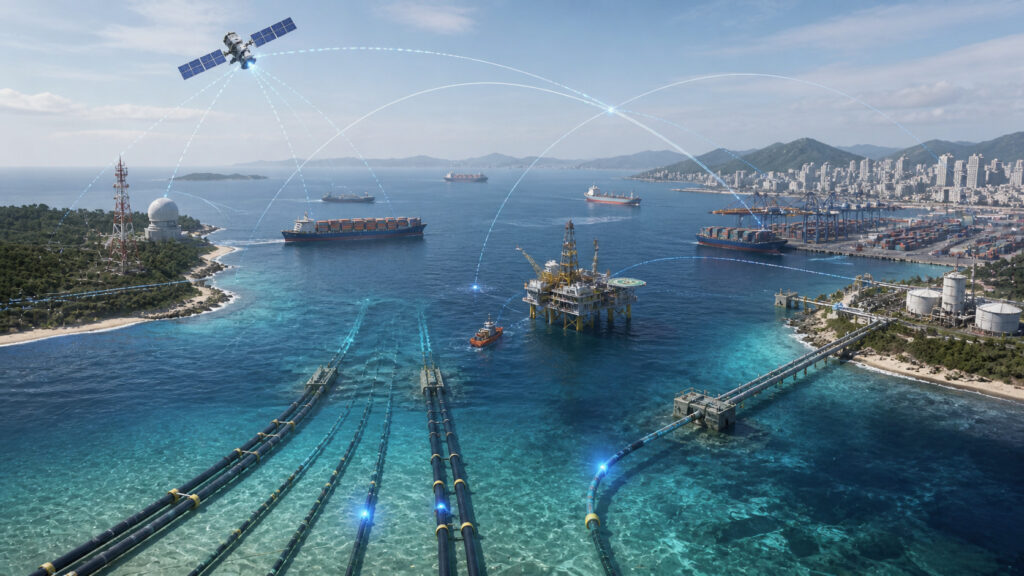
For much of the post-Cold War period, critical infrastructure was largely viewed through an economic lens. Ports facilitated international commerce, pipelines supplied energy to industrial economies, undersea communication cables enabled global financial transactions, and electricity networks supported increasingly interconnected societies. Governments invested heavily in protecting these assets against natural disasters, industrial accidents, and cybercrime, yet relatively little strategic attention was devoted to the possibility that such infrastructure could become primary targets within geopolitical competition. The dominant assumption was that globalization had created mutual dependence sufficiently strong to discourage deliberate attacks against systems upon which both economic prosperity and international stability relied.
That assumption has steadily eroded over the past decade. The strategic environment has evolved into one characterized by persistent competition below the threshold of conventional war, where states increasingly employ economic pressure, cyber operations, intelligence activities, disinformation campaigns, and coercive diplomacy to weaken rivals without triggering direct military confrontation. Within this evolving landscape, critical infrastructure has emerged as one of the most attractive instruments of strategic coercion. Rather than targeting military bases or conventional armed forces, contemporary geopolitical competition increasingly focuses on disrupting the physical systems that sustain modern economies and national resilience.
This transformation reflects a broader shift in strategic thinking. Modern societies are more interconnected and technologically dependent than at any previous point in history. Electricity grids, gas pipelines, liquefied natural gas terminals, container ports, digital communication networks, satellite systems, and submarine fibre-optic cables form an integrated architecture supporting virtually every dimension of national power. Financial markets depend upon uninterrupted digital connectivity. Energy security depends upon resilient transport infrastructure. Military operations increasingly rely on civilian communications networks. Global supply chains require continuously functioning ports and maritime logistics. Consequently, disrupting a relatively limited number of critical infrastructure nodes can generate cascading effects far exceeding the immediate physical damage.
The experience of recent years has demonstrated that infrastructure disruption can achieve strategic objectives that previously required large-scale military operations. Damage to an offshore pipeline may increase energy prices across an entire continent. Interference with submarine communications cables can interrupt financial transactions, degrade military command systems, and undermine digital connectivity across multiple countries simultaneously. Congestion or disruption at major container ports can delay industrial production, weaken export capacity, increase inflationary pressures, and expose vulnerabilities throughout international supply chains. The strategic value of such operations lies precisely in their disproportionate consequences: relatively limited actions can generate significant political, economic, and psychological effects while preserving ambiguity regarding responsibility.
Submarine communication cables illustrate this new strategic reality more clearly than perhaps any other element of modern infrastructure. Despite widespread public perception that global communications rely primarily upon satellites, approximately 95 percent of international digital data is transmitted through fibre-optic cables laid across the seabed. Financial transactions worth trillions of dollars, government communications, cloud computing services, military information exchange, and internet connectivity all depend upon this largely invisible network extending across the world’s oceans. Although physically remote, these cables constitute one of the least visible yet most indispensable components of the global economy. Their increasing strategic significance has transformed them from commercial infrastructure into assets of national security importance.
Energy infrastructure occupies an equally central position within contemporary geopolitical competition. The weaponization of energy has become a defining characteristic of international relations during the past decade. Pipelines transporting natural gas and crude oil have evolved beyond their traditional commercial role to become instruments of political influence, economic leverage, and strategic pressure. Governments increasingly evaluate pipeline routes not solely according to commercial efficiency but also according to geopolitical resilience. Diversification of suppliers, redundancy in transportation networks, and the protection of offshore infrastructure have therefore become fundamental components of national security planning rather than purely economic policy.
Maritime infrastructure has experienced a similar transformation. Ports once regarded primarily as commercial gateways are now recognized as strategic assets capable of influencing regional security, military logistics, and economic resilience. Modern ports integrate digital management systems, automated cargo handling, energy terminals, telecommunications infrastructure, and transportation networks linking domestic industries with global markets. Their disruption—whether through cyberattacks, sabotage, or hybrid operations—can significantly reduce a nation’s ability to sustain both economic activity and military readiness. Consequently, governments increasingly consider port security inseparable from broader national defence strategies.
The convergence of physical and digital infrastructure has further complicated the strategic environment. Critical infrastructure no longer exists as isolated physical assets but as interconnected systems managed through sophisticated digital technologies. Pipelines depend upon industrial control systems, ports rely upon automated logistics platforms, electricity grids utilize smart network management, and telecommunications infrastructure operates through globally integrated digital architectures. This convergence creates new vulnerabilities because physical disruption may be accompanied—or even preceded—by cyber operations targeting operational technologies responsible for managing essential services. Hybrid campaigns combining cyber intrusion with physical sabotage therefore represent an increasingly credible threat scenario for governments and security planners.
Europe has become one of the principal theatres in which these challenges are most visible. The continent possesses one of the world’s most interconnected energy, transport, and digital infrastructures while simultaneously confronting heightened geopolitical tensions along its eastern and northern peripheries. Offshore energy installations in the North Sea, electricity interconnectors linking national grids, extensive networks of submarine communication cables in the Baltic Sea, and major container ports serving global trade collectively represent both strategic strengths and potential vulnerabilities. Recent incidents involving undersea infrastructure have reinforced concerns regarding the adequacy of existing surveillance capabilities, legal frameworks, and multinational coordination mechanisms for protecting these assets against increasingly sophisticated threats.
The strategic importance of critical infrastructure will continue to expand as technological transformation accelerates. Artificial intelligence, cloud computing, renewable energy systems, offshore wind installations, hydrogen transport networks, and next-generation telecommunications will further increase societal dependence upon resilient infrastructure. Future geopolitical competition is therefore unlikely to focus exclusively on territorial control or conventional military superiority. Instead, it will increasingly revolve around the ability to protect, disrupt, or influence the infrastructure upon which economic prosperity, technological innovation, military effectiveness, and political stability ultimately depend.
Understanding this transformation requires abandoning the traditional distinction between civilian infrastructure and national security. In the twenty-first century, pipelines, submarine cables, ports, electricity grids, and digital networks have become strategic assets comparable in importance to military bases, naval fleets, and air defence systems. Protecting these interconnected systems is no longer simply an engineering challenge or a commercial responsibility; it has become a defining requirement of national resilience and one of the central strategic priorities shaping international security in an era of intensifying geopolitical competition.
The Rise of Hybrid Warfare: Infrastructure as a Battlefield
The transformation of critical infrastructure into a primary arena of geopolitical competition reflects a broader evolution in the character of conflict itself. Contemporary strategic rivalry rarely begins with conventional military operations or formal declarations of war. Instead, states increasingly pursue political objectives through activities designed to remain below the threshold that would trigger a collective military response. Cyber intrusions, economic coercion, disinformation campaigns, intelligence operations, election interference, and infrastructure disruption have become central components of what security analysts broadly define as hybrid warfare. Within this framework, pipelines, submarine communication cables, ports, electricity grids, rail networks, and digital communication systems have emerged as strategic targets capable of generating significant political and economic pressure without necessarily provoking immediate military escalation.
Hybrid warfare deliberately exploits ambiguity. Unlike conventional military attacks, operations targeting infrastructure often create uncertainty regarding attribution, intent, and legal responsibility. Damage to an underwater cable may initially appear to result from technical malfunction, severe weather, or accidental anchoring before evidence suggests possible deliberate interference. Similarly, disruptions affecting energy networks or port operations may initially be interpreted as industrial accidents or cyber failures rather than hostile actions. This ambiguity provides strategic advantages to hostile actors by delaying political decision-making, complicating collective responses, and reducing the likelihood of rapid retaliation.
One of the defining characteristics of hybrid operations is their ability to generate disproportionate strategic effects through comparatively limited actions. A single disruption affecting an important energy corridor may trigger electricity shortages, industrial production losses, inflationary pressure, and political instability extending far beyond the immediate location of the incident. Likewise, interference with major ports can interrupt supply chains supporting manufacturing sectors across multiple countries, while damage to telecommunications infrastructure may affect financial markets, emergency services, and military communications simultaneously. The objective is not necessarily physical destruction alone but rather the creation of uncertainty, economic disruption, and political pressure capable of weakening an adversary’s strategic resilience over time.
The maritime domain has become particularly significant within this evolving security environment. Much of the world’s critical infrastructure is concentrated beneath or adjacent to the oceans, including submarine communication cables, offshore energy installations, natural gas pipelines, oil terminals, electricity interconnectors, and strategic shipping routes. These assets operate across vast geographical areas where continuous surveillance remains technically difficult and legally complex. The combination of extensive infrastructure networks, increasing commercial traffic, and overlapping national jurisdictions creates an operational environment in which hostile activities may be difficult to detect before significant damage has already occurred.
The Baltic Sea has emerged as one of the most strategically sensitive maritime environments in Europe. It combines dense concentrations of critical infrastructure with growing military activity, commercial shipping, and heightened geopolitical tension. Offshore wind farms, liquefied natural gas terminals, undersea communication cables, electricity connectors, and major ports coexist within relatively confined waters shared by several NATO members and neighbouring states. This concentration of infrastructure creates both strategic opportunities and strategic vulnerabilities. Any disruption affecting one component of this interconnected network may rapidly generate consequences extending across multiple sectors, including energy security, digital communications, transportation, and regional defence planning.
Ports represent another increasingly important dimension of hybrid competition. Modern ports function as highly integrated logistical ecosystems rather than simple cargo terminals. Their operations depend upon digital customs systems, automated cargo management platforms, satellite navigation, industrial control technologies, financial payment systems, and transportation networks linking maritime commerce with domestic economies. As a result, cyberattacks directed against port management systems may achieve effects comparable to physical sabotage by delaying cargo movements, disrupting customs processing, or interrupting logistical coordination. Because many national economies rely heavily upon maritime imports and exports, even temporary disruption of major ports can generate extensive economic consequences.
Energy infrastructure has similarly become a focal point of strategic competition because of its direct relationship with national resilience. Modern industrial economies depend upon uninterrupted supplies of electricity, natural gas, petroleum products, and increasingly renewable energy generated through interconnected regional networks. Disruption affecting offshore production facilities, transmission infrastructure, or cross-border interconnectors can influence not only domestic energy availability but also regional electricity markets and industrial competitiveness. Consequently, protecting energy infrastructure has evolved into a strategic priority encompassing intelligence cooperation, maritime surveillance, cyber defence, regulatory oversight, and military preparedness.
An additional challenge arises from the growing convergence of cyber and physical threats. Increasing digitalization has significantly improved the efficiency of infrastructure management while simultaneously expanding potential attack surfaces. Industrial control systems responsible for pipeline pressure regulation, electricity distribution, railway signalling, and port automation are increasingly connected to broader digital networks. Although operators have strengthened cybersecurity considerably, sophisticated adversaries continue seeking opportunities to exploit vulnerabilities capable of producing physical consequences through digital means. Future infrastructure attacks may therefore combine cyber intrusion, electronic warfare, misinformation campaigns, and physical sabotage within a single coordinated operation designed to maximize confusion while complicating attribution.
The legal and political dimensions of infrastructure protection remain equally challenging. International law was largely developed around traditional concepts of armed conflict involving identifiable military forces operating within recognized theatres of war. Hybrid operations targeting civilian infrastructure frequently occupy a legal grey zone where existing international frameworks provide limited guidance regarding proportional responses, attribution standards, or collective defence obligations. Governments therefore face complex strategic decisions when determining whether particular incidents constitute criminal acts, intelligence operations, economic coercion, sabotage, or armed attacks requiring broader national security responses.
For NATO and the European Union, these developments have accelerated a fundamental reassessment of resilience as an element of collective security. Defence planning increasingly recognizes that military readiness depends upon secure civilian infrastructure capable of supporting logistics, communications, transportation, energy supply, and industrial production during periods of crisis. Consequently, resilience has evolved from a primarily civil protection concept into an essential pillar of deterrence strategy. Protecting infrastructure now requires unprecedented cooperation among armed forces, intelligence services, coast guards, private operators, regulatory agencies, technology companies, and international partners responsible for managing assets that often cross national jurisdictions.
Looking ahead, the strategic importance of infrastructure protection will continue to increase as geopolitical competition intensifies. The expansion of offshore renewable energy, digital communications, autonomous shipping, artificial intelligence, and globally integrated supply chains will deepen dependence upon complex infrastructure networks whose disruption could produce increasingly severe consequences. Future conflicts are therefore unlikely to be defined solely by military engagements on land, at sea, or in the air. They will also be shaped by the ability of states to anticipate, protect, and rapidly recover from attacks directed against the infrastructure that sustains modern society. In this environment, resilience is no longer simply a defensive objective—it has become a decisive component of national power and an indispensable foundation for long-term strategic stability.
Protecting the Global Lifelines: NATO, the European Union, and the Future of Critical Infrastructure Security
The growing strategic importance of critical infrastructure has fundamentally altered the way governments define national security. During much of the twentieth century, defence planning focused primarily on protecting territory, military installations, and population centres from conventional attack. In contrast, twenty-first century security increasingly depends upon the uninterrupted functioning of complex civilian systems that enable economic activity, military mobility, digital communications, and societal resilience. As a result, pipelines, submarine communication cables, offshore energy installations, ports, electricity grids, satellite networks, and transportation corridors have become integral components of national defence planning. Their protection is no longer regarded as a technical or commercial responsibility alone but as a strategic imperative requiring sustained cooperation between governments, armed forces, intelligence agencies, regulators, and private-sector operators.
For NATO, this transformation represents one of the most significant strategic adaptations since the end of the Cold War. The Alliance has traditionally concentrated on collective territorial defence, emphasizing military readiness, force projection, and deterrence against conventional aggression. However, the emergence of hybrid threats has expanded NATO’s understanding of security beyond the battlefield. Military superiority alone cannot guarantee national resilience if adversaries are capable of disrupting the civilian infrastructure that supports military logistics, communications, energy distribution, and industrial production. Consequently, resilience has become a core element of NATO’s deterrence strategy, reflecting the recognition that military operations are inseparable from the civilian systems upon which they depend.
This evolution has become particularly evident across Northern Europe and the Baltic region. The enlargement of NATO has significantly strengthened the Alliance’s northern flank while simultaneously increasing the strategic importance of maritime infrastructure located in the Baltic Sea and the North Sea. These waters contain dense networks of undersea fibre-optic cables, electricity interconnectors, offshore wind installations, liquefied natural gas terminals, and commercial shipping routes linking Northern Europe with global markets. Their proximity to areas of heightened geopolitical competition has elevated infrastructure protection from a regional concern to an Alliance-wide strategic priority.
The European Union has undertaken a parallel transformation in its approach to infrastructure security. Traditionally, European policy concentrated on market regulation, energy diversification, transport integration, and digital connectivity. While these objectives remain essential, recent geopolitical developments have demonstrated that economic integration alone cannot guarantee resilience against deliberate disruption. The EU has therefore increasingly incorporated security considerations into energy policy, cyber resilience, transport regulation, and digital governance. The objective is not merely to improve efficiency but to reduce strategic vulnerabilities capable of being exploited during periods of political or military tension.
One of the defining challenges facing both NATO and the European Union lies in the shared responsibility for protecting infrastructure that is predominantly owned and operated by private entities. Telecommunications companies, port operators, electricity providers, pipeline operators, and logistics firms collectively manage much of the infrastructure upon which national security now depends. This reality requires an unprecedented level of public-private cooperation. Governments possess intelligence capabilities, military assets, and regulatory authority, while private operators maintain the technical expertise, operational awareness, and maintenance responsibilities necessary for day-to-day infrastructure management. Building effective resilience therefore depends upon integrating these complementary capabilities within coherent national security frameworks.
Maritime surveillance has become an increasingly important component of this effort. Advances in satellite imagery, unmanned maritime systems, artificial intelligence, and underwater sensing technologies are gradually improving governments’ ability to monitor critical infrastructure across extensive maritime environments. Continuous observation of vessel movements, offshore installations, submarine cables, and strategic shipping corridors enables authorities to identify unusual patterns of activity that may warrant closer investigation. Rather than relying solely upon reactive responses after incidents occur, European governments are increasingly investing in persistent maritime domain awareness designed to detect potential threats before they escalate into significant security crises.
Cybersecurity represents another indispensable pillar of infrastructure protection. Modern critical infrastructure depends heavily upon interconnected digital control systems responsible for monitoring operational performance, regulating industrial processes, and coordinating complex logistics networks. While digitalization has improved efficiency, it has also expanded potential vulnerabilities. Protecting operational technology requires continuous investment in network segmentation, threat detection, software resilience, secure communications, and workforce training. Governments increasingly recognize that cybersecurity should not be treated as an isolated technical discipline but as an essential component of national resilience integrated with intelligence collection, military planning, and emergency management.
Equally important is the development of strategic redundancy. Resilient infrastructure cannot rely upon single points of failure. Diversified energy supplies, multiple communication routes, alternative transportation corridors, reserve electricity capacity, and redundant digital networks significantly reduce the effectiveness of attempts to disrupt essential services. Europe has increasingly accelerated investments in liquefied natural gas infrastructure, cross-border electricity interconnections, renewable energy generation, and diversified communication systems precisely because redundancy enhances resilience. Although these investments often require substantial financial resources, they provide long-term strategic benefits by reducing dependence upon individual assets whose disruption could otherwise produce disproportionate national consequences.
International cooperation will remain essential because critical infrastructure rarely conforms to national boundaries. Submarine communication cables connect multiple continents, energy pipelines cross several jurisdictions, electricity grids operate across interconnected regional markets, and shipping routes serve global supply chains extending far beyond individual states. Effective protection therefore depends upon intelligence sharing, harmonized regulatory standards, coordinated maritime surveillance, joint military exercises, and common emergency response procedures among allied governments. No single country possesses sufficient visibility or resources to secure every component of these interconnected systems independently.
Looking toward the next decade, technological change will further reshape infrastructure security. Offshore renewable energy installations, hydrogen transportation networks, quantum communications, autonomous maritime systems, artificial intelligence, and increasingly sophisticated satellite constellations will create new strategic opportunities while simultaneously expanding potential vulnerabilities. As societies become progressively more digital and interconnected, adversaries may find even greater incentives to target infrastructure capable of generating widespread disruption without crossing the threshold of conventional armed conflict. The distinction between economic security and national defence is therefore likely to continue diminishing as technological dependence deepens.
The future of deterrence will increasingly depend not only on military capability but also on resilience. States capable of rapidly detecting, absorbing, and recovering from infrastructure disruption will possess significant strategic advantages over those whose essential systems remain fragile or poorly coordinated. Resilience should therefore be understood as an active component of deterrence rather than merely a defensive measure. Adversaries are less likely to target infrastructure whose operators can rapidly restore services, whose governments can attribute hostile activity with confidence, and whose allies are prepared to coordinate political, economic, and security responses.
Ultimately, the weaponization of critical infrastructure represents one of the defining strategic challenges of the twenty-first century. Global competition is no longer confined to armies, navies, or air forces; it increasingly encompasses the physical and digital systems that sustain economic prosperity, technological innovation, and political stability. Pipelines, submarine communication cables, ports, energy networks, and transportation corridors have become the lifelines of modern civilization. Their protection is therefore inseparable from the preservation of international stability itself. Governments that succeed in strengthening the resilience of these interconnected systems will be better positioned to deter coercion, withstand future crises, and maintain strategic freedom of action in an era defined by persistent geopolitical competition.
Strategic Outlook and Policy Recommendations
Preparing Critical Infrastructure for the Next Era of Geopolitical Competition