Executive Summary
Asia is projected to spend nearly US$630 billion on defence in 2026, continuing a trend of uninterrupted military expenditure growth that has persisted for almost two decades. While rising tensions with China and growing pressure from the United States remain key drivers of military modernization across the region, defence spending decisions are increasingly shaped by a more complex combination of threat perceptions, domestic political priorities, economic performance, and fiscal constraints.
The region is witnessing an unprecedented military buildup, yet this expansion is occurring at a time of mounting economic uncertainty. The economic consequences of the Iran conflict, disruptions in global energy markets, rising food prices, and slowing economic growth threaten to constrain future defence budgets, particularly in developing economies across Southeast Asia. As governments attempt to balance security needs against economic pressures, Asia is entering a new phase in which defence spending will be determined not only by strategic competition but also by economic resilience.
Introduction
The strategic landscape of Asia is undergoing a profound transformation.
Over the past decade, the region has emerged as the epicenter of global geopolitical competition. China’s military expansion, North Korea’s missile development, territorial disputes in the South China Sea, tensions across the Taiwan Strait, and growing rivalry between Washington and Beijing have fundamentally reshaped regional security calculations.
In response, defence spending across Asia has risen steadily.
According to recent projections, Asian military expenditure will increase by 3.4 percent in real terms during 2026, bringing total regional defence spending close to US$630 billion. Although this represents slower growth than the average annual increase recorded during the previous decade, it nevertheless reflects the continued prioritization of security investments throughout the region.
Yet the current wave of military spending differs from previous periods. Rather than being driven by a single security threat, defence investments are increasingly shaped by diverse national priorities and competing economic pressures.
China’s Military Rise as the Primary Driver
China remains the single most important factor shaping Asian defence spending.
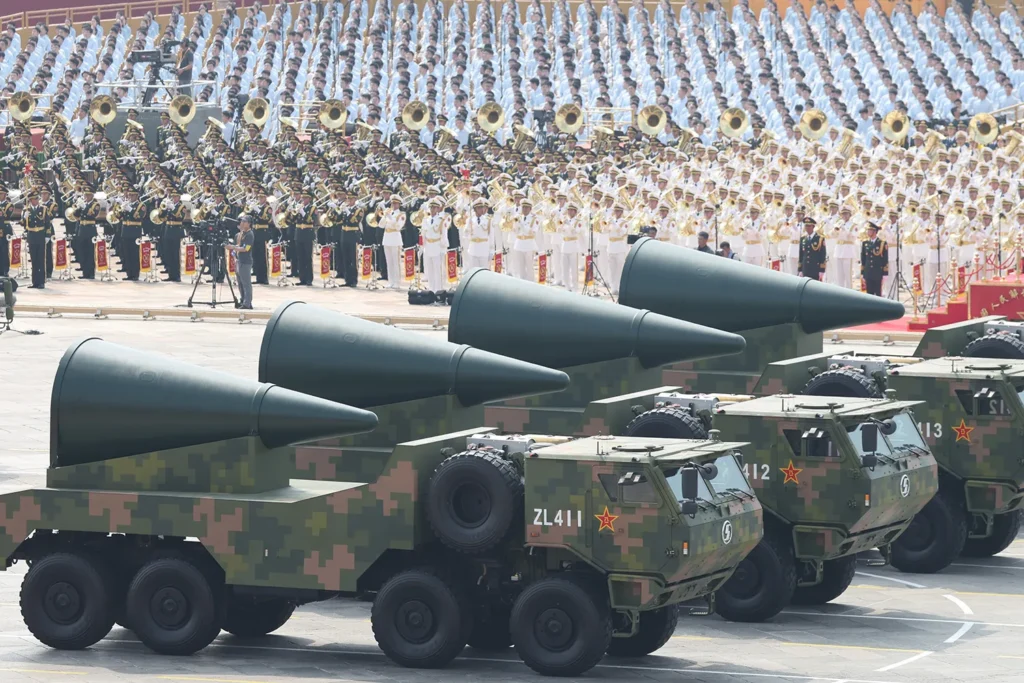
Beijing now accounts for more than 40 percent of total defence expenditure across Asia, making it the dominant military actor in the region. In 2026, China’s official defence budget increased by approximately 6.4 percent in real terms, reaching more than US$270 billion. Notably, military spending continues to grow faster than the country’s projected economic growth rate.
Chinese military modernization encompasses advanced missile systems, naval expansion, cyber capabilities, artificial intelligence applications, space assets, and increasingly sophisticated airpower. These developments have generated concern among neighboring countries, many of which perceive Beijing’s growing capabilities as altering the regional balance of power.
As a result, several governments have accelerated their own modernization programs in an effort to maintain deterrence and strategic flexibility.
American Pressure and the Globalization of NATO Spending Targets
The United States has played an increasingly visible role in encouraging higher defence spending among Asian allies and partners.
Senior American officials have repeatedly argued that countries facing growing security challenges should contribute a larger share of their national wealth toward defence. Comparisons with NATO spending targets have become increasingly common in discussions involving key partners such as Australia, Japan, South Korea, and Taiwan.
This shift reflects a broader evolution in American strategic thinking.
Washington increasingly expects regional partners to assume greater responsibility for their own security while contributing more actively to collective deterrence efforts. Consequently, defence spending has become not only a military issue but also a political indicator of alliance commitment.
Several governments have responded by publicly highlighting defence expenditures as a percentage of GDP, mirroring approaches traditionally associated with NATO members.
Taiwan and the New Frontline of Strategic Competition
No country illustrates this trend more clearly than Taiwan.
Amid rising tensions with Beijing, Taiwan significantly increased defence allocations in 2026, with spending reaching approximately 3.3 percent of GDP according to official calculations. This expansion reflects growing concerns regarding China’s military activities around the island and the possibility of future coercive actions.
Taiwan’s military modernization focuses heavily on asymmetric capabilities, including missile systems, drones, coastal defence, and cyber resilience. Rather than attempting to match China’s military power directly, Taipei aims to increase the costs and risks associated with any potential military operation against the island.
The Taiwanese case increasingly serves as a model for smaller states seeking to deter larger adversaries through innovation and strategic adaptation.
Different Threats, Different Priorities
Although concerns about China dominate many strategic discussions, security priorities vary significantly across Asia.
For India, competition with China remains important, but tensions with Pakistan continue to shape defence planning. Following renewed military confrontations between the two countries, both governments increased defence spending substantially.
South Korea remains primarily focused on North Korea’s nuclear and missile capabilities. Seoul’s defence budget is projected to rise sharply in 2026 as part of broader modernization efforts aimed at maintaining deterrence on the Korean Peninsula.
In Southeast Asia, threat perceptions are even more diverse. While the Philippines increasingly views China as a direct security challenge, many other states prioritize domestic stability, maritime security, counterterrorism, and internal governance concerns.
These variations demonstrate that Asian defence spending cannot be explained solely through the lens of great-power competition.
Southeast Asia’s Modernization Efforts
Southeast Asia represents one of the most dynamic regions for military modernization.
Indonesia, for example, has undertaken an ambitious effort to upgrade aging military equipment through its long-term modernization strategy. Recent years have witnessed major investments in transport aircraft, submarines, naval assets, and airpower. However, procurement cycles often create fluctuations in annual defence budgets, producing temporary spikes followed by periods of stabilization.
The Philippines continues implementing its long-term modernization agenda, focusing on maritime surveillance, naval expansion, and air defence capabilities. Increasing tensions in the South China Sea have accelerated efforts to strengthen military readiness and strategic partnerships.
Across the region, modernization increasingly emphasizes technological capabilities rather than simply increasing troop numbers.
The Economic Consequences of the Iran Conflict
While strategic tensions continue driving defence investments, economic realities are beginning to impose new constraints.
The recent conflict involving Iran generated significant disruptions in global energy markets, particularly through instability affecting the Strait of Hormuz. Because Asia imports the majority of energy exports passing through this critical maritime corridor, the region remains especially vulnerable to supply disruptions and price increases.
Rising energy costs have increased inflationary pressures, elevated transportation expenses, and contributed to broader economic uncertainty. Several governments have already announced additional spending measures to offset higher fuel and energy prices.
At the same time, international organizations project slower economic growth across much of Asia during 2026, reducing the fiscal flexibility available for defence expansion.
The Return of the Guns-versus-Butter Debate
The interaction between security needs and economic constraints is reviving a classic policy dilemma: should governments prioritize military spending or social and economic development?
This debate is particularly relevant in Southeast Asia, where many countries continue facing infrastructure needs, healthcare challenges, education demands, and economic inequality.
As governments confront tighter budgets, defence procurement programs often become the first targets for delays, restructuring, or reductions. Major weapons acquisitions may therefore face increasing scrutiny during the coming years.
The challenge for policymakers will be maintaining military modernization while preserving economic stability and public support.
Defence Industrial Resilience as a Strategic Priority
One of the most important lessons emerging from recent conflicts is the need for stronger defence-industrial capacity.
The wars in Ukraine and the Middle East have demonstrated that military effectiveness increasingly depends on the ability to sustain production of ammunition, drones, missiles, and advanced technologies during prolonged crises.
Asian governments are therefore placing greater emphasis on domestic defence industries, technology transfer agreements, and regional production partnerships.
Building industrial resilience is becoming as important as purchasing military platforms themselves.
Countries capable of producing critical defence equipment domestically will enjoy greater strategic flexibility and reduced dependence on external suppliers.
Conclusion
Asia’s defence spending trajectory reflects the emergence of a more contested and uncertain security environment.
China’s military rise, growing American expectations, regional disputes, and evolving threat perceptions continue driving military modernization across the continent. Yet economic realities are increasingly shaping how governments respond to these challenges.
The consequences of the Iran conflict, energy market disruptions, and slowing economic growth demonstrate that defence spending cannot be separated from broader economic conditions. Future military investments will depend not only on strategic necessity but also on fiscal sustainability.
The coming decade is therefore likely to be defined by a delicate balancing act. Asian governments must strengthen security capabilities while managing economic pressures, maintaining social stability, and preserving long-term development goals.
How successfully they navigate this balance will play a decisive role in shaping the future security architecture of the Indo-Pacific region.